A Lowcountry Boil Is Not a Recipe. It’s a Social Contract About How to Eat Together.
Every element of a Lowcountry boil points toward the same conclusion: this is not a dish designed for a dining room. The pot is too large. The serving vessel is a table covered in newspaper. There are no plates. Nobody sits. The shrimp have to be peeled by the people eating them, which means everyone’s hands are busy and no one is checking their phone. The whole structure of the meal forces the kind of attention and presence that most food occasions only gesture toward. That is not an accident of tradition. It is the tradition.
What a Lowcountry Boil Actually Is
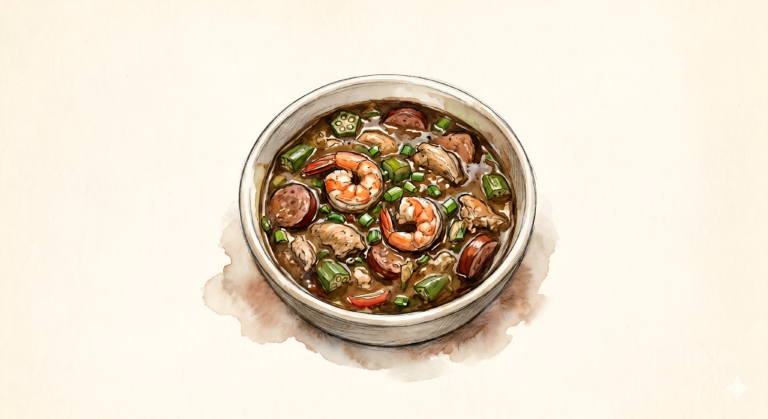
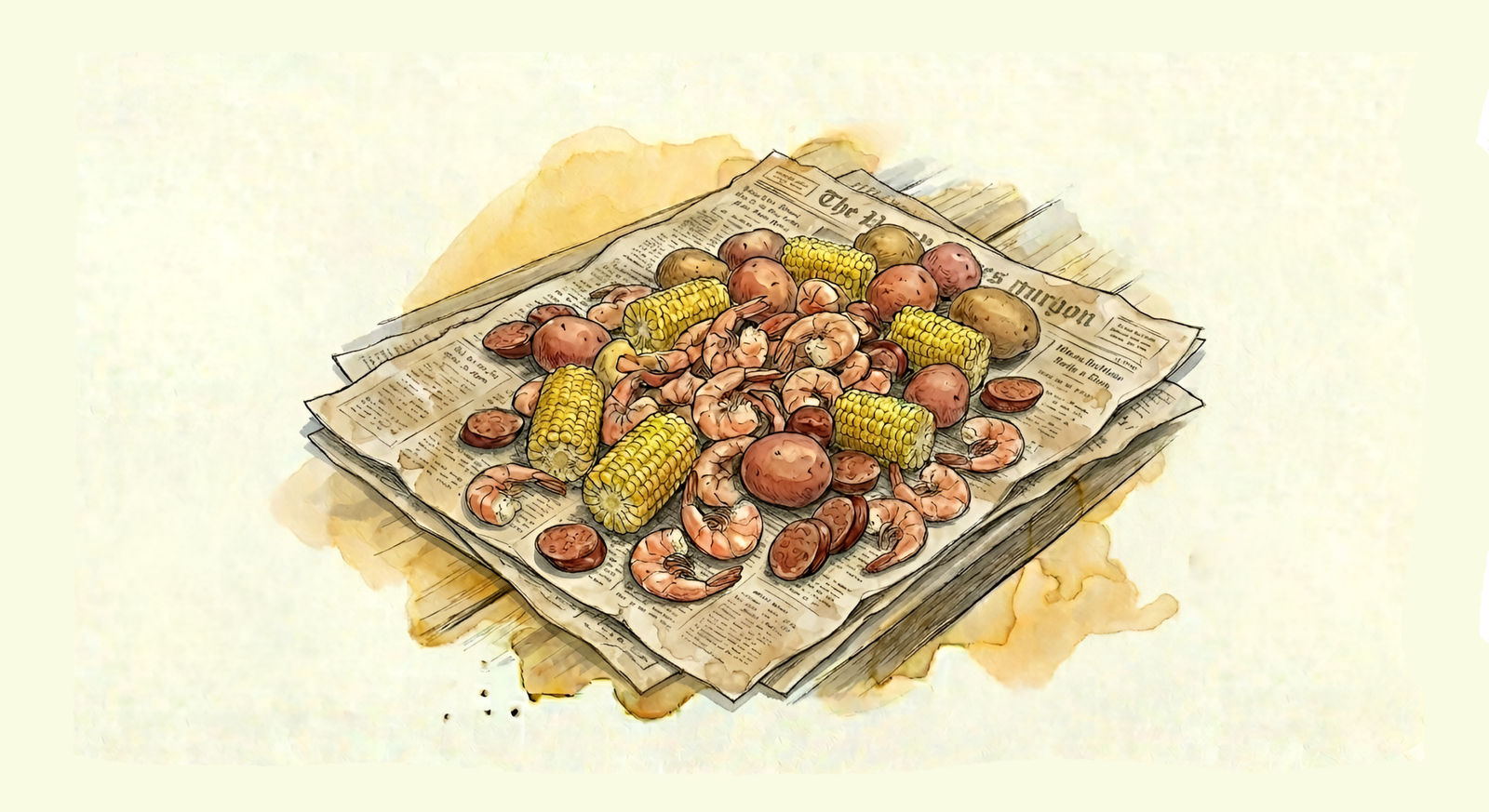
A Lowcountry boil is a single-pot meal of shell-on shrimp, corn on the cob, smoked sausage, and new potatoes cooked together in heavily seasoned water — then drained and dumped directly onto a newspaper-covered table for a group to eat communally. There are no utensils. There is cocktail sauce, drawn butter, and hot sauce on the table. That is the complete dish.
The simplicity is structural, not accidental. Each ingredient is chosen because it can withstand the boil without falling apart: whole corn sections hold their texture, new potatoes stay firm, smoked sausage slices release fat into the water without disintegrating, and shell-on shrimp cook in minutes and retain their flavor inside the shell. This dish is engineered for a large pot over a propane burner in someone’s backyard, not a restaurant kitchen.
Lowcountry Boil vs. Frogmore Stew: The Same Dish, Two Names
Frogmore Stew is the older name and the more specific one. It comes from Frogmore, a community on St. Helena Island in Beaufort County, South Carolina — one of the Sea Islands that preserved Gullah Geechee culture and traditions more completely than most of the mainland South. The dish is attributed to Richard Gay of Gay Fish Company, who is said to have fed it to National Guard troops training on the island in the 1960s.
Lowcountry Boil is the broader, more marketed name that spread as the dish traveled beyond the Sea Islands into the wider South Carolina and Georgia coastal culture. Part of the name shift has a bureaucratic explanation: in the 1980s, the US Postal Service retired the Frogmore post office name, which accelerated the disappearance of “Frogmore Stew” from tourism media and menus. Lowcountry Boil is what you see in food media now. Frogmore Stew is what people from Beaufort still call it.
Knowing the Frogmore Stew origin situates the dish in its actual cultural history. It did not emerge from general Southern cooking. It came from a specific community on a specific island with a specific foodway, and that specificity is what gives it meaning beyond a convenient one-pot meal.
The Seasoning: Old Bay vs. the Lowcountry Approach
Old Bay is the seasoning most associated with Lowcountry boil in national food media, and the association is not wrong — it works. But Old Bay is a Maryland product developed for Chesapeake Bay seafood, and in the Lowcountry it has always competed with local spice blends that reflect the region’s own flavor preferences.
The traditional Lowcountry seasoning is heavier on black pepper, cayenne, and bay leaf, with less of the celery salt that defines Old Bay’s profile. The Gullah Geechee tradition leans into the spice more assertively, and the water in a properly seasoned boil should be almost too spicy to sip — because the shrimp, corn, and potatoes are only in that water for minutes and need maximum seasoning contact. Coastal Carolina seafood shops and markets sell “Frogmore Stew seasoning” in mesh bags — the bag drops into the water and the spices infuse through it — and these local blends are calibrated specifically for this dish in a way that a general-purpose seasoning is not.
The seasoning has to be in the water. Doubling what the recipe says is almost always correct.
Zatarains Crab Boil, used more commonly in Louisiana-influenced contexts, produces a different flavor profile — more anise and allspice, less celery. Using it is not a violation, but it moves the dish toward a different culinary tradition. Both are valid. They taste different, and knowing which one is in the pot tells you something about the cook’s influences.
The Shrimp Question: What to Use and When
The shrimp is the non-negotiable ingredient, and its quality determines the quality of the boil more than any other factor. Shell-on is mandatory — the shell protects the meat during the boil and concentrates the flavor inside. Peeled shrimp in a boil produce rubbery, diluted results. The shell-on requirement is a technical decision, not a tradition artifact.
Wild-caught South Carolina white shrimp, harvested in fall from the coastal waters of the ACE Basin and the sea island estuaries, are the shrimp the dish was built around. The major harvest — what local fishermen call “fall whites” — runs from late August through December, with the peak in October and November. They are larger and sweeter than most farmed alternatives and carry the salinity of the specific estuaries where they were caught. A Lowcountry boil made with local white shrimp in October is a different dish from one made with imported farmed shrimp in July.
Brown shrimp, which run April through September in South Carolina waters, are smaller and more assertively flavored. They work in a boil but produce a stronger, more iodine-forward result. Gulf white shrimp, peaking July through October, are a legitimate substitute with a slightly different flavor profile. Frozen imported shrimp with no regional provenance diminish the dish in proportion to how far they are from the water this meal was built around.
The Order of the Pot: Why Timing Matters
The most common mistake is putting everything in at once. Each ingredient has a different cook time, and the goal is for everything to finish simultaneously.
Potatoes go in first, in well-seasoned boiling water, and cook for fifteen to twenty minutes — longer if they are larger red bliss potatoes rather than small new potatoes. Sausage goes in next for five to seven minutes. Corn goes in for three to four minutes. Shrimp go in last and cook for two to three minutes until pink and opaque throughout. The pot comes off the heat, everything drains, and it goes directly to the table.
Overcooked shrimp — rubbery, tightly curled, white throughout with no translucence — are the most common failure. Two to three minutes is the window. Three and a half minutes is already past it. Standing over the pot for the final stage is not optional.
How to Serve It Correctly
Spread newspaper or butcher paper over a large outdoor table, drain the pot, and dump the contents directly in the center. Provide cocktail sauce, drawn butter, Crystal hot sauce, lemon wedges, and a stack of paper towels. That is the complete service.
Plates make the occasion smaller. The social dynamic of a Lowcountry boil depends on everyone eating from the same pile. The newspaper is not a quirky presentation choice. It signals immediately that this is a standing-around-the-table occasion, and the disposable surface is correct for a meal this messy.
Bread — specifically good crusty bread for soaking up the seasoned liquid that pools on the newspaper — is the most underrated addition. The liquid that comes off a well-seasoned boil when it hits the table is as good as anything in the pot.
What This Is Not
A Lowcountry boil is not a crawfish boil, though the formats are similar enough that people conflate them. A crawfish boil is a Louisiana tradition built around a different crustacean, a different seasoning approach, and a different set of cultural associations. The communal format overlaps. The dish does not.
A Lowcountry boil is not primarily a restaurant dish. Restaurants serve it, and some serve it well, but the occasion is diminished when it moves indoors onto individual plates. If you are eating it at a restaurant table with a fork, you are eating a version adapted for a different context. The original context — outdoors, standing, communal, messy — is the full experience.
The Tailgate Case: Why This Works on Southern Campuses
A Lowcountry boil is close to the ideal tailgate food for any Southern campus within reasonable distance of the coast. One pot feeds a crowd — a single large pot handles twenty to thirty people without a second thought. The setup is a propane burner and a stock pot, which means it travels. The serving method requires no plates, no utensils, and no infrastructure beyond a table and newspaper. And once the shrimp go in, the whole thing is done in under three minutes.
The social dynamic is the other argument. A tailgate crowd before a game is not a single team’s fans — it is a mix of people who root for opposing sides but share a parking lot and a meal. A Lowcountry boil is genuinely neutral territory. Everyone stands around the same pile of food with the same hands. The mechanics of the meal — the peeling, the shared pile, the absence of individual plates — are not compatible with keeping your distance from the people next to you. The dish enforces a kind of fellowship that stadium food and individual servings do not produce.
For coastal South Carolina schools specifically — Clemson within striking distance of the ACE Basin, South Carolina even closer — the shrimp can be sourced fresh the morning of the game during fall season. The meal that results from a tailgate built around a pot of local October white shrimp is not the same experience as burgers off a portable grill. It is specific to where you are and when you are there, which is what Southern football weekends at their best actually feel like.
Where to Eat and How to Find the Real Thing
Restaurants in Charleston and Beaufort serve Lowcountry boil year-round. The shrimp quality varies by season — October through December is when to order it if you want local white shrimp.
The better experience is a community boil or private gathering. St. Helena Island and the greater Beaufort area host shrimp boils as community events through fall. The ACE Basin and Cape Romain areas are where the shrimp come from and where the tradition is most intact.
If you are in the region between September and November and someone invites you to a backyard shrimp boil, that is the correct version of this meal. It is not better than a restaurant version because it is less formal. It is better because the shrimp are more likely to be local, the seasoning more likely to be calibrated by someone who has done it dozens of times, and the occasion has not been adapted for people who expect to sit down.
How to Think About a Lowcountry Boil: The Transferable Framework
Two questions determine whether a Lowcountry boil is worth having. First: what are the shrimp? Wild-caught, shell-on, and sourced from somewhere specific is the correct answer. Second: is it being served the way it was designed — communally, from a shared surface, with hands?
A Lowcountry boil made with excellent local shrimp, properly seasoned water, and eaten standing around a table with people paying attention to the food is one of the best eating experiences the South produces. The same recipe made with inferior shrimp and served on individual plates indoors is a reasonable meal. The gap between those two experiences is not technique. It is context, and context here is almost everything.