Gumbo Is Not a Soup. The Roux Is the Whole Argument.
Gumbo Is Not a Soup. The Roux Is the Whole Argument.
Gumbo is defined by how it is built, not what is in it. The roux is where it begins, and the color of that roux tells you almost everything about the bowl before you taste it.
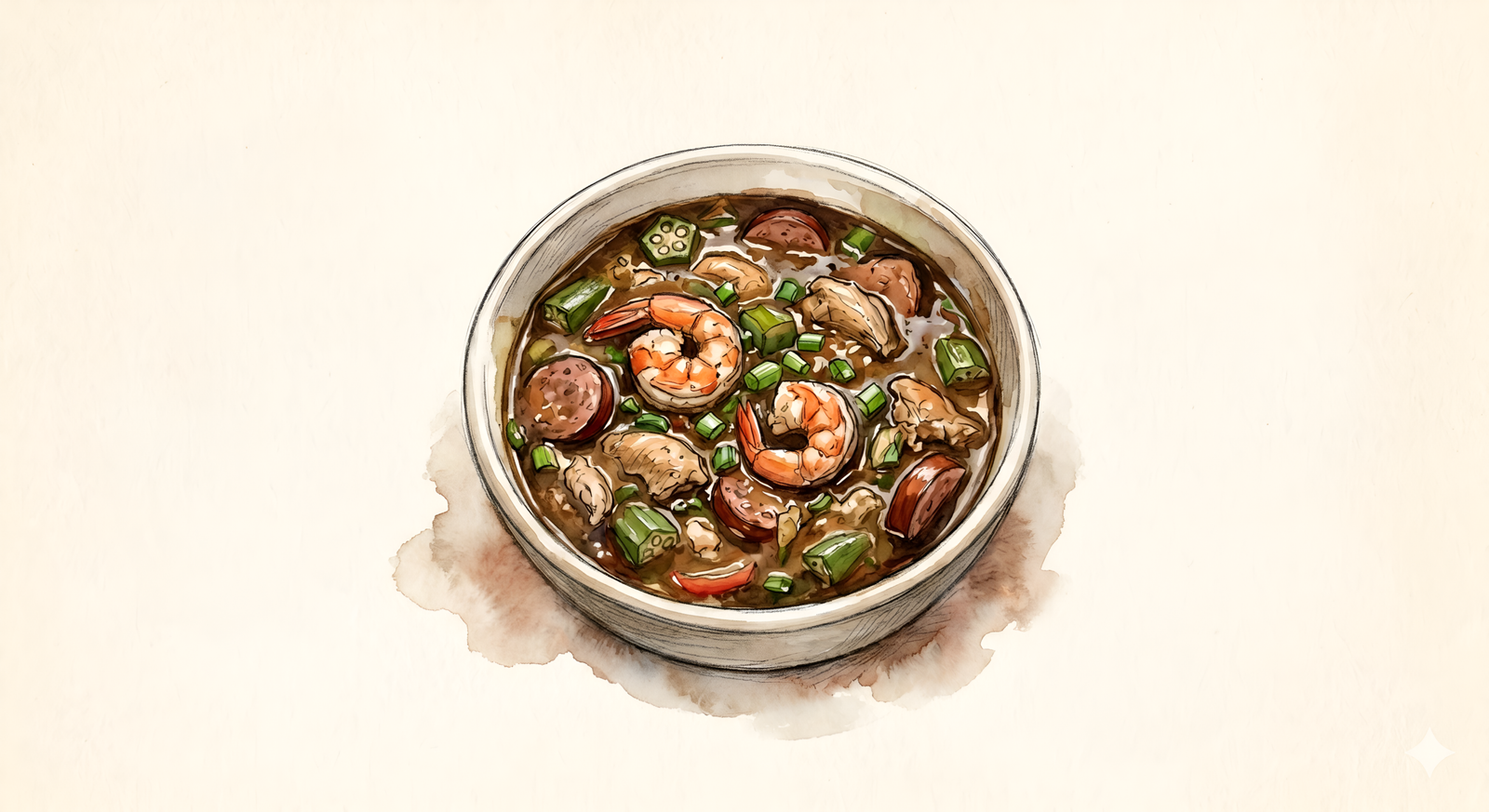
Gumbo resists easy categorization because most people try to categorize it by what is in it — shrimp, chicken, sausage, okra — when the dish is actually defined by how it is built. The roux is where gumbo begins, and the color of that roux tells you almost everything about the bowl before you taste it: the flavor depth, the thickening method, whether you are eating a Creole or Cajun tradition, and how much of the cooking happened before the protein ever touched the pot.
What a Roux Is and Why It Takes So Long
A roux is flour cooked in fat. In French cooking it is a quick process done in minutes. In Louisiana cooking it is a commitment — a dark Cajun roux takes forty-five minutes to an hour of constant stirring over medium heat. It cannot be rushed. Walk away and it burns. Let the heat climb and it scorches.
The longer a roux cooks, the more the starch granules break down and flavor compounds develop. A blond roux is mostly starch and a little flavor. A dark roux is mostly flavor and almost no starch — which means a Cajun gumbo built on a dark roux needs other agents to reach the right consistency, while a lighter Creole roux does more thickening on its own.
The roux provides gumbo’s flavor foundation in a way nothing else does. Andouille, shrimp, crab, and okra build on top of what the roux established. A gumbo with a properly developed dark roux and no protein is still recognizably gumbo. A gumbo with great protein and a pale, underdeveloped roux is not.
The bowl’s color is a direct readout of how the roux was cooked and which tradition built the dish.
| Roux Color | Cook Time | Thickening | Flavor | Tradition | What to Expect |
|---|---|---|---|---|---|
| White – Blond | 5–10 min | High | Mild, neutral — roux is background | French base | Thick body; protein and aromatics dominate |
| Peanut Butter | 20–30 min | Moderate | Toasty, nutty beginning to develop | Light Creole | Rich, opaque sauce; roux and protein in balance |
| Brick Red | 30–40 min | Lower | Deep nuttiness; flavor clearly present in every spoonful | Creole–Cajun | Color deepens noticeably; complex background throughout |
| Dark Chocolate | 45–60 min | Minimal | Intense — nutty, almost coffee-like; the roux is the dominant flavor | Cajun | Thinner consistency; requires okra or filé to thicken; roux flavor in every spoonful |
A dark brown Cajun gumbo and a lighter, richer New Orleans Creole gumbo are not two versions of the same dish. They are two distinct traditions that share a name. The color tells you which one you are eating before you taste it.
Cajun vs. Creole: Two Traditions, One Name
Cajun gumbo comes from the Acadiana parishes of southwestern Louisiana, settled by French-speaking exiles expelled from Canada in the eighteenth century. It is built on a very dark roux, uses the trinity of onion, celery, and bell pepper as its aromatic base, and typically features chicken and andouille. It is a land-based dish from a rural cooking culture where the roux was developed over a wood stove before anything else happened. The flavor of the roux is the dish.
Creole gumbo comes from New Orleans — a port city with Gulf seafood access, a French and Spanish colonial history, and a professional cooking culture rooted in Creole kitchens. It uses a lighter roux and features seafood: shrimp, blue crab, oysters. Tomato may appear in a Creole gumbo where it never appears in a Cajun one, though many serious New Orleans Creole kitchens skip it. The consistency is richer and more sauce-like.
These traditions overlap constantly. A New Orleans kitchen may serve a seafood gumbo on a dark roux. An Acadiana cook may add shrimp. The distinction is not a rule but an origin story, and understanding the origin tells you what the cook was optimizing for.
Gumbo is unique because it has three distinct thickening agents, each tied to a different season and tradition. Most bowls use one primary thickener; some use two.
| Thickener | What It Is | Season | Character | How It Arrives |
|---|---|---|---|---|
| Roux | Flour cooked in fat — the base of virtually every gumbo regardless of what else follows | Year-round | Flavor depth and body; the darker the roux, the less starch remains and the more the flavor dominates | Built first — before any protein or liquid enters the pot. Everything else is built on this. |
| Okra | Pods cooked until they break down; mucilage creates body different from starch thickening | Summer — peaks July through October | Looser, slightly silky texture; vegetable sweetness underneath. Fresh okra in August tastes meaningfully different from frozen in January. | Cooked into the pot; cannot be added at the table |
| Filé | Ground sassafras leaves — thickener and flavoring both | Fall and winter — traditional when okra is out of season | Herbal, slightly root-beer quality; integrates into long-cooked gumbo differently than starch | Often served at the table — not in the pot. Filé added to boiling liquid becomes stringy. A bottle on the table means the kitchen expects you to finish the bowl yourself. |
Ordering gumbo in October in New Orleans is not the same experience as ordering it in July. The season determines which thickener the kitchen is working with, and that changes the bowl.
Gumbo Z’Herbes: The Holy Thursday Tradition
Gumbo z’herbes is the most distinct gumbo tradition in Louisiana and the least understood outside it. It is a green gumbo made from leafy greens — mustard, collards, turnip greens, cabbage, watercress — rooted in the Holy Thursday tradition of eating simply before the Good Friday fast. The tradition holds that you include an odd number of greens (most kitchens use 7, 9, or 11 varieties; an even number is considered bad luck), and that for each variety you add, you will make a new friend in the coming year.
Leah Chase at Dooky Chase’s Restaurant made gumbo z’herbes into a Holy Thursday feast rather than an abstinence meal, loading her version with brisket, ham, and several types of sausage. Her logic: eat well before the fast, not poorly. The Dooky Chase’s version became the city’s standard. Chase passed in 2019; the restaurant continues under the Chase family’s leadership, run by her grandson Chef Edgar “Dooky” Chase IV and her daughter Stella Chase Reese. The z’herbes is served once a year on Holy Thursday only — the reason to plan around the calendar if this is the visit.
How to Order Gumbo
The rice ratio. Gumbo is served over white rice. The correct proportion is enough gumbo to sauce the rice. If the rice is drowning, the kitchen is being generous. If the gumbo is sparse and rice overwhelms it, something went wrong. The bowl should read as gumbo with rice, not rice with gumbo liquid.
The filé question. If there is a bottle on the table, add it sparingly — a small amount, stir it through, taste. Filé can overpower a delicately flavored seafood gumbo. On a heavily spiced chicken and andouille it disappears.
Ask whether the gumbo is made daily. Most serious gumbo kitchens make their roux and stock in-house. A gumbo built from a commercial base will taste different — usually thinner.
One regional note worth knowing: In the Cajun prairie parishes — particularly Evangeline Parish (Mamou), St. Landry Parish (Eunice), and Acadia Parish (Church Point) — gumbo is often served with a scoop of potato salad either alongside the bowl or dropped directly into it. This tradition is especially tied to the Courir de Mardi Gras, the rural Mardi Gras run, where the day culminates in a massive communal gumbo served with potato salad. It is not an aberration. The correct response is to try it before forming an opinion.
Where to Eat Gumbo
Some of the best gumbo in Louisiana gets made in parking lots. On a cold November Saturday before an LSU game in Baton Rouge, a serious tailgate cook will have a dark roux going on a propane burner, stirring for the better part of an hour before anyone sees a pot of stock. The result, ladled over rice out of a styrofoam cup, can be as good as anything served in a dining room. This is not a romantic observation. It is proof that gumbo is a technique dish, not a restaurant dish. The roux takes the same time whether it is built on a commercial range in New Orleans or over a burner in a parking lot. What changes the outcome is whether the cook knows what they are doing and cares about the result.
| Restaurant | Neighborhood | Order | Notes |
|---|---|---|---|
| Dooky Chase’s Restaurant | Trémé | Creole gumbo Z’Herbes: Holy Thursday only | Leah Chase cooked here for decades before her passing in 2019. Her Creole gumbo remains the city’s reference point. The restaurant continues under the Chase family’s leadership — her grandson Chef Edgar “Dooky” Chase IV and her daughter Stella Chase Reese. The gumbo z’herbes is served once a year on Holy Thursday only; plan around the calendar if this is the visit. |
| Mandina’s | Mid-City | Working-class Creole gumbo | Operating since 1932 — the building was a grocery store from 1898; Sebastian Mandina’s sons converted it to a restaurant in 1932. Unpretentious and consistent; the room is the opposite of a tourist experience. The most reliable neighborhood version in the city. |
Any gumbo that arrives at the table in under ten minutes was not made in that kitchen. Roux development alone takes the better part of an hour. A fast gumbo is a commercial base gumbo and will taste like one.
What to Skip
Any gumbo that arrives in under ten minutes was not made in that kitchen. Roux development alone takes the better part of an hour. A fast gumbo is a commercial base gumbo and will taste like one.
Gumbo served in a bread bowl is a tourist product. The bread dissolves and turns the whole thing to mush. The dish does not need a container. Bourbon Street gumbo warrants the same skepticism as Bourbon Street po’boys — better versions exist within a short walk.
How to Think About Gumbo: The Transferable Framework
Before you taste a bowl of gumbo, you can read it. The color tells you how dark the roux was cooked and which tradition built the dish. The consistency tells you which thickener is doing the work. The protein tells you whether you are eating a Creole seafood tradition or a Cajun land-based one. The presence of okra tells you something about the season. The filé on the table tells you the kitchen expects you to finish the seasoning yourself.
None of that requires tasting the bowl. It requires knowing what to look for. Once you have the framework, every bowl of gumbo you encounter becomes more legible: you know what the cook was doing before the spoon reaches your mouth, and you know how to evaluate whether they did it well.
Similar Posts
Southern Peach Varieties and Season Guide: When to Buy and Why It Matters
The best peaches and cream pie you will ever eat requires one specific type of peach, harvested in a window of about two weeks in late August, eaten within a day or two of leaving the tree. Everything else is a compromise the cook makes up for with sugar. My wife makes this pie every…
Central Texas Brisket Is a Post-Oak and Time Argument. Everything Else Is a Variation.
Brisket is a specific cut from a specific place on the animal, cooked over a specific wood for a specific duration, with a rub so minimal it borders on no rub at all. What makes Central Texas brisket distinctive is not a secret technique or a proprietary seasoning blend. It is the decision to let…
Shrimp and Grits in Charleston: What Makes It Different Here
You Can Order Shrimp and Grits Anywhere. The Version in Charleston Is a Different Argument. You can order shrimp and grits in a thousand restaurants across the country. The version you get in Charleston is different, and the reason is not the recipe. It is the ingredients and the people cooking them. Shrimp pulled from…
Gulf Oysters and Eastern Oysters Are the Same Species. The Water Makes Them Different Foods.
A raw oyster from Apalachicola and a raw oyster from the Virginia coast are biologically the same animal: Crassostrea virginica, the Eastern oyster, the only species that matters for most of what gets eaten in the American South. What separates them is not genetics. It is water. The temperature, salinity, tidal flow, and food sources…
Vidalia Onions: The Only American Onion With a Federal Appellation
A Vidalia onion is not a variety of onion. It is a place. The Granex hybrid seed that produces a Vidalia grows in fields across the South, and in most of them it produces an onion with the sharpness and sulfur bite of any other yellow onion. Plant that same seed in the sandy loam…
Lowcountry Cuisine Explained: What It Is, Where It Comes From, and Why It Tastes the Way It Does
Lowcountry Cuisine Is Not a Style. It Is a Geography, a History, and a Set of Ingredients That Cannot Be Separated From Either. Lowcountry cuisine is what happens when a specific geography forces specific ingredient choices, and several distinct groups of people each adapt their culinary traditions to work within those constraints. The result is…