Tennessee Whiskey vs. Bourbon: They Are Not the Same Thing
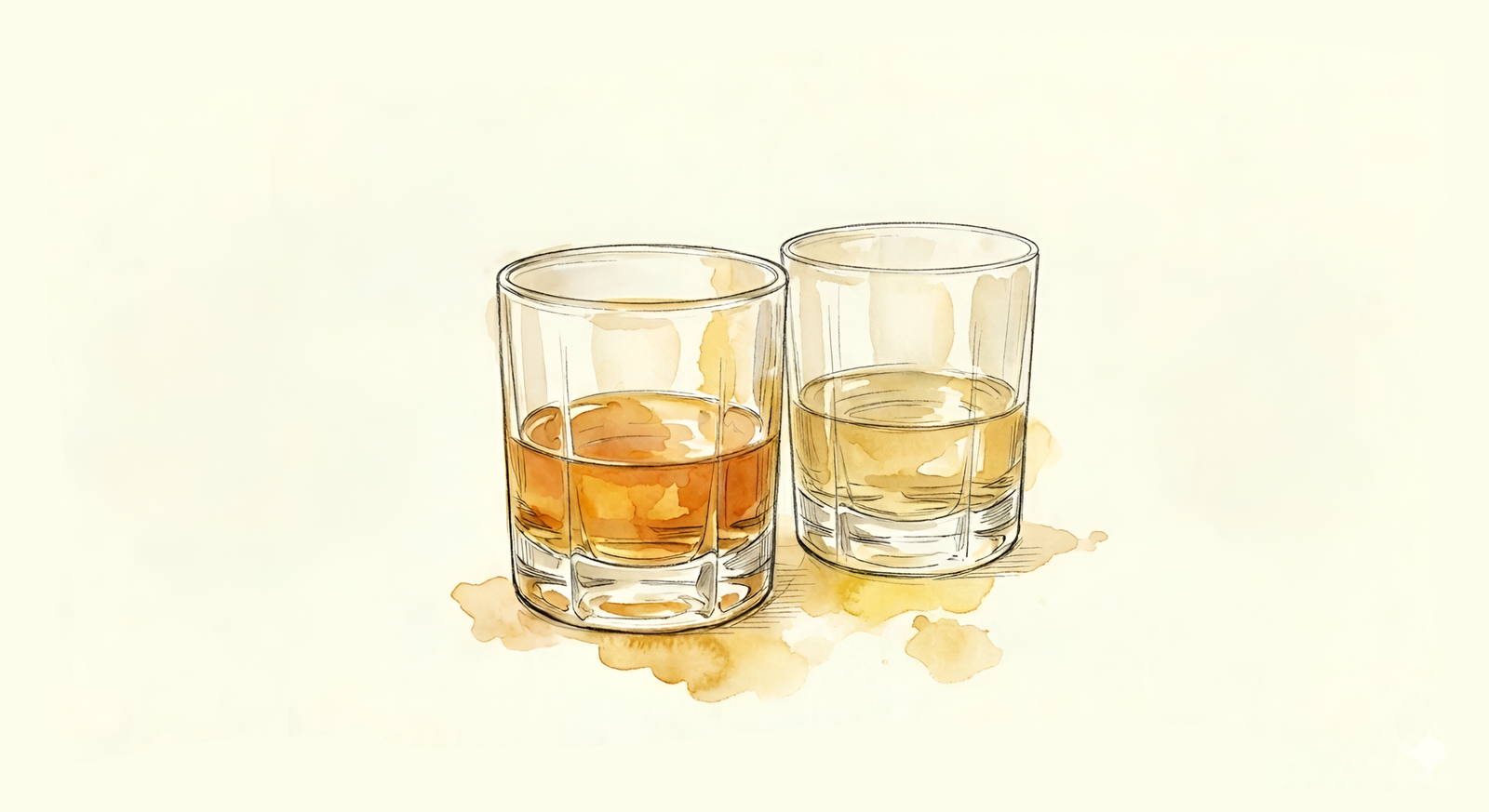
Tennessee whiskey and bourbon are not the same thing. Both are American whiskeys, both are made primarily from corn, and both age in charred new oak barrels — but Tennessee whiskey goes through one additional step that bourbon does not, and that step changes the character of the spirit before it ever touches wood. The distinction matters not just as a production question but as a question of identity: the people who drink Tennessee whiskey and the people who drink Kentucky bourbon are not having the same conversation, and knowing why tells you how to think about every bottle in either category.
All Bourbon Is Whiskey. Not All Whiskey Is Bourbon.
The federal government defines bourbon with specific requirements under 27 CFR Part 5: fermented from a grain mixture of at least 51 percent corn, distilled to no more than 160 proof, entered into charred new oak barrels at no more than 125 proof, and produced in the United States. Straight bourbon is also the only American whiskey designation for which the federal standard of identity prohibits all coloring, flavoring, and blending materials. Blended bourbon — a separate designation requiring at least 51% straight bourbon — may contain additives up to 2.5% by volume. What most people mean when they say bourbon is straight bourbon, and that product is additive-free by law.
Within that definition, bourbon can be made anywhere in the United States. A distillery in New York, Colorado, or Texas can produce legitimate bourbon. Kentucky bourbon is bourbon made and aged in Kentucky, which is worth specifying because the state’s limestone-filtered water, the temperature swings that push the spirit in and out of the barrel’s wood, and a production culture built over two centuries produce results that other states are still working toward.
What Makes Tennessee Whiskey Different
Tennessee whiskey meets every federal requirement for bourbon and adds one more step: the Lincoln County Process. Before the spirit enters a barrel, it is filtered slowly through sugar maple charcoal. This happens at the distillery, before aging, and it removes certain congeners and compounds that would otherwise carry through into the barrel. The result is a spirit that is mellower at barrel entry than a comparable bourbon would be — and that mellowness stays in the finished product.
The name is a historical artifact. Jack Daniel’s distillery sits in Moore County, which was once part of Lincoln County before Tennessee redrew its county lines. The process kept its name; the geography changed around it.
Tennessee state law defines the category separately from federal regulation: a spirit may only be called Tennessee whiskey if it is made in Tennessee, uses at least 51 percent corn, ages in new charred oak, and goes through the charcoal filtration. There is one exception: Benjamin Prichard’s distillery was grandfathered out of the Lincoln County Process requirement when Tennessee codified the rule in 2013, and legally calls its product Tennessee whiskey without the filtration step. It is the only one. Jack Daniel’s and George Dickel are the two major producers who follow the full process. Both make spirits that meet bourbon’s federal requirements, and both choose to call themselves Tennessee whiskey instead.
Why Jack Daniel’s Is Not Bourbon (And Why That Is a Choice)
Jack Daniel’s qualifies as bourbon under federal law. The grain bill, the distillation proof, the barrel requirements — it meets all of them. The company has chosen not to use the bourbon label, and the reason is that Tennessee whiskey is what it is. The Lincoln County Process produces a spirit with a character distinct enough that calling it bourbon would be technically accurate and substantively misleading.
This matters because it clarifies where the distinction actually lives. It is not that Tennessee whiskey falls short of bourbon’s definition. It is that the producers have chosen a different identity, grounded in a process that bourbon does not require and would not permit them to advertise if they used the bourbon label.
This Is an Identity Argument as Much as a Taste Argument
Think of it like SEC football. Every team is playing the same game on the same field under the same rulebook. But Alabama and Tennessee do not run the same offense, do not recruit the same way, and do not define success the same way — and the people in the stands are not neutral observers who might switch allegiances if presented with a compelling argument. The loyalty is the point. The rivalry is the point.
Bourbon and Tennessee whiskey work the same way. Both are American-made spirits, both built on corn, both aged in charred American oak, both governed by the same federal rulebook. But Kentucky bourbon and Tennessee whiskey have developed distinct game plans over two centuries — bourbon optimizing for range of expression and barrel-driven complexity, Tennessee whiskey optimizing for consistency and accessibility through the Lincoln County Process — and the people who identify with each tradition are not waiting to be convinced by the other side.
Asking a serious Kentucky bourbon drinker and a serious Jack Daniel’s drinker to settle which tradition is more legitimate is roughly equivalent to asking an Alabama fan and a Tennessee fan to agree on which program is historically superior. The argument is beside the point. Both traditions are genuine, both have real depth, and the people most invested in each are not primarily trying to convert anyone.
Tennessee whiskey and Kentucky bourbon occupy different cultural positions in the South. Kentucky bourbon carries the weight of distillery heritage, the vocabulary of mash bills and barrel char levels, and a tasting culture that its most serious practitioners have spent years building. Tennessee whiskey is more vernacular — the bottle at the hunting camp, the pour at the tailgate, the spirit that shows up in more Southern kitchens than any bourbon does. Neither of those is a diminishment. They are just different programs.
What Kentucky Bourbon Does Best
The range of expression in Kentucky bourbon is wider than in Tennessee whiskey, and the Lincoln County Process is largely responsible for that difference. Without the charcoal filtration, bourbon carries more of its raw distillate character into the barrel. What the wood does to it over years — combined with where the barrel sat in the rickhouse and how long it stayed there — produces a spectrum of outcomes that Tennessee whiskey does not attempt to match.
High-rye bourbons carry a spice and grain-forward character that the charcoal filtration suppresses. Wheated bourbons lean softer and sweeter. Single barrel selections from the same distillery can taste as though they came from different producers. That variability is part of the appeal, and chasing it is the basis of a serious bourbon education.
What Tennessee Whiskey Does Best
Tennessee whiskey is more consistent and more approachable across producers than bourbon, and the charcoal filtration is the reason. The process creates a baseline mellowness that makes the spirit easier to drink without dilution and more forgiving in food and cocktail contexts. A Tennessee whiskey highball is a reliable, unfussy thing. A highball built on a barrel-proof, high-rye Kentucky bourbon is a different kind of experience that requires more specific conditions to work.
That relative restraint also means Tennessee whiskey tends to work more cleanly alongside food than many bourbons do. At a barbecue, with fried chicken, or poured at a table where the spirit is in the background rather than the foreground, Tennessee whiskey is the easier choice.
How to Approach Each One
Start with what you are using it for. Sipping neat, with attention, Kentucky bourbon rewards the investment. To understand what the category can do, try a wheated bourbon alongside a high-rye expression from the same distillery, then add a single barrel selection. Each bottle will teach you something different about what the mash bill and the barrel are capable of.
For Tennessee whiskey, Jack Daniel’s Old No. 7 is the right starting point — not because it is the best expression but because it is the reference point, the way Prince’s is the reference point for Nashville hot chicken. Once you have that baseline, George Dickel No. 12 is the natural comparison. Dickel chills its whisky to around 40°F before it enters the charcoal vats, and allows the spirit to soak rather than trickle through. Jack Daniel’s filters at room temperature, gravity-fed through the charcoal. The difference in process produces a difference in character that is worth tasting side by side.
The Framework: How to Think About American Whiskey
All bourbon is whiskey. Not all whiskey is bourbon. Tennessee whiskey is a category that meets bourbon’s requirements and adds one more — and that addition changes the spirit in ways that are not subtle.
Beyond the production question, the choice between bourbon and Tennessee whiskey is as much about identity and context as about flavor. Know the legal definition. Understand what the Lincoln County Process does and why producers who could call their product bourbon choose not to. Then pick your team and drink accordingly. That framework holds for every American whiskey you encounter after this one.