Carolina BBQ Is a Debate About the Animal, Not the Sauce
The argument over Eastern vs. Western Carolina barbecue gets framed as a sauce debate, and that framing misses the point. The sauce difference is real, but it is a consequence of a more fundamental disagreement: whether you cook the whole animal or just part of it. That decision determines everything downstream — what the meat tastes like, what the sauce needs to do, and why putting tomato in an Eastern pitmaster’s sauce is not just a preference violation but a category error.
What Eastern North Carolina Barbecue Actually Is
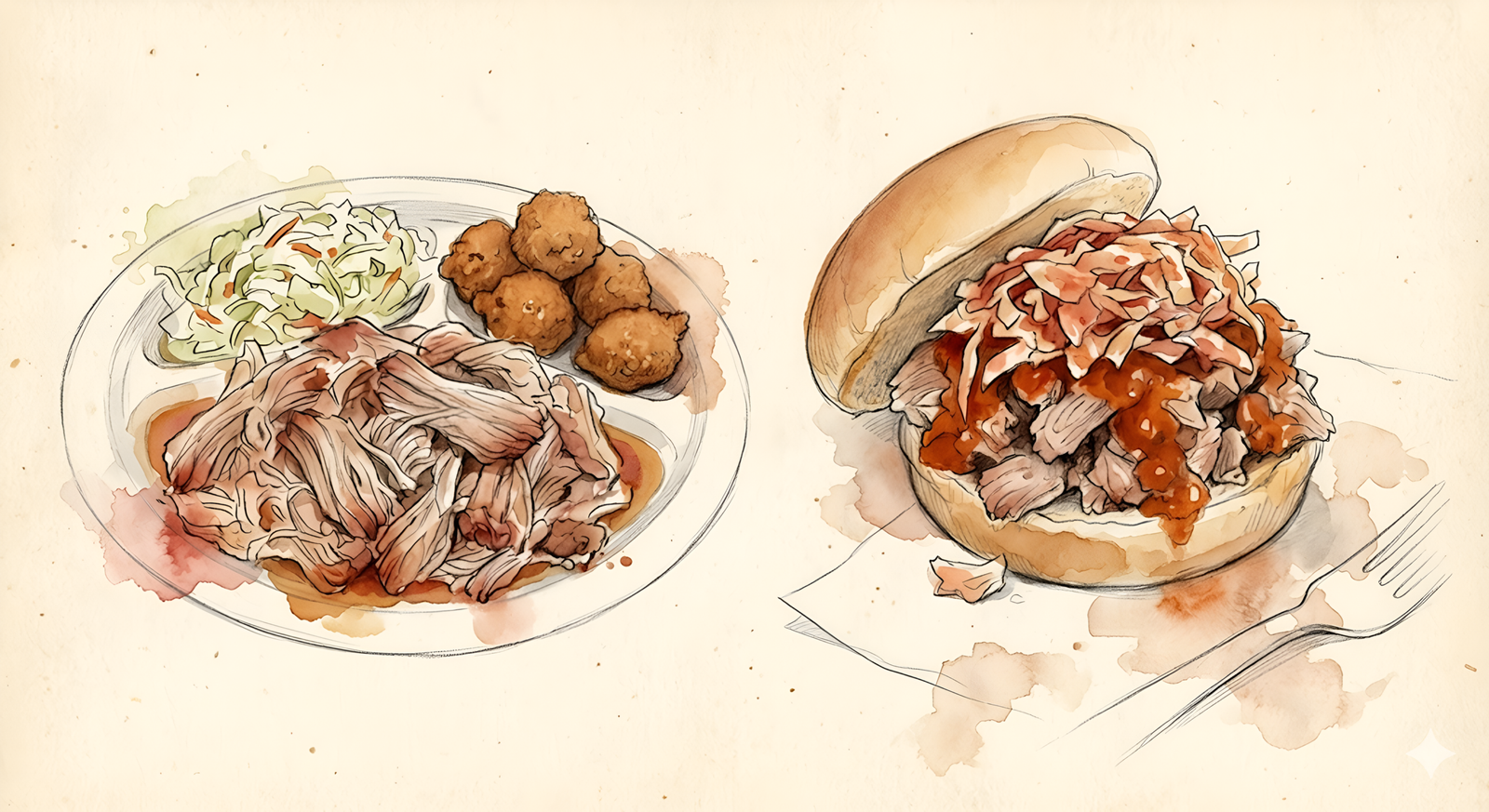
Eastern North Carolina barbecue is whole hog. The entire pig goes on the pit — loin, shoulder, ham, belly, head. It cooks overnight over hardwood coals, typically hickory or oak, and the result is a range of textures and fat levels across the animal that no single-cut barbecue can produce. In a well-run Eastern kitchen, the skin is removed during the cook, crackled separately until it shatters, then chopped back into the meat. That crackling distributed through the pile is the hallmark of a pitmaster who knows what they are doing. The crispy skin, the lean loin, the fatty shoulder, and the gelatinous bits near the head all end up chopped together. That combination is the product.
The sauce — if you call it a sauce — is cider vinegar, red pepper flakes, salt, and sometimes a small amount of sugar. Nothing else. No tomato. No ketchup. No sweetener beyond a trace amount. The logic is exact: a whole hog produces a lot of fat. The vinegar’s job is to cut through that fat and brighten the meat’s natural flavor. A sauce with body, sweetness, or tomato would compete with a product that is already complex from the variety of cuts. The vinegar supports. It does not lead.
This tradition is older than the Western style and predates ketchup as a national condiment. Eastern NC pitmasters regard their approach as the original form, and the argument has the history to support it.
What Western North Carolina Barbecue — Lexington Style — Actually Is
West of roughly the I-85 corridor — the modern road approximation of the geological fall line that separates the Piedmont from the Coastal Plain — the tradition shifts from whole hog to pork shoulder only. Shoulder is a single uniform cut with a consistent fat content throughout. It cooks faster than a whole hog, it is easier to manage at scale, and it produces a more predictable product. These are not criticisms. They are the conditions that led to a different sauce.
The Lexington-style sauce — called “dip” in the region — is vinegar and ketchup, slightly sweet, with red pepper and sometimes Worcestershire. It is thinner than Kansas City sauce and still acidic enough to penetrate the meat, but the tomato adds body and a mild sweetness that works with shoulder in a way it would not work with a whole hog. In a Lexington kitchen, the dip functions as a finishing liquid applied to the meat before serving and as the base for the red slaw. It is not slathered. It seasons.
The red slaw is the other Lexington marker: coleslaw dressed with a tomato-vinegar-based dressing rather than mayonnaise. The slight sweetness of the slaw echoes the dip, and the pairing is specific to the Piedmont tradition. It does not exist in Eastern NC, where coleslaw is white and the idea of tomato in any BBQ-adjacent context raises a reaction.
Lexington, NC takes its identity as a barbecue town seriously. The city has more barbecue restaurants per capita than anywhere else in the state. Lexington Barbecue #1 — known locally as Monk’s — has been the reference point for the style since Wayne “Monk” Monk opened it in 1962.
The Vinegar Question Is the Tell
Ask any North Carolina pitmaster whether tomato belongs in a barbecue sauce and the answer tells you exactly where they are from and what tradition they are defending.
An Eastern pitmaster will say no. Not as a preference — as a matter of principle. The whole hog is rich enough that it does not need a sauce with its own flavor character. What it needs is acid. The vinegar is a tool, not a condiment. Adding tomato changes the tool into something that has opinions about the meat, and the meat does not need opinions. It needs to taste like what it is.
A Lexington pitmaster will say the tomato is what makes the dip, not a violation of it. The shoulder is leaner and more uniform, and a sauce with body complements it. The sweetness is calibrated. The acid is still there. It is a different answer to the same question — how do you make pork taste like itself — not a corruption of the Eastern answer.
Neither is wrong. They are solutions to different problems produced by different starting points. The whole hog produces one set of constraints. The shoulder produces another. Understanding that the sauce follows the cut explains why the argument cannot be resolved. It is not a debate about which sauce is better. It is a debate about what the dish fundamentally is.
The most honest version of that answer is also the most personal one. I grew up eating Lexington-style in western NC. My wife grew up on Eastern. We agree that pork is best and that each of us is biased toward what we ate first. That bias is not a failure of objectivity. It is how regional food traditions actually work. The style that formed your palate earliest is the one that tastes like the real thing. Both of us are right, which means neither of us is.
South Carolina’s Third Answer: Mustard
North Carolina’s internal argument tends to crowd out the fact that South Carolina developed its own distinct tradition that owes nothing to either Eastern or Lexington style. In the SC midlands, particularly the Dutch Fork area settled by German immigrants in the eighteenth century, the sauce is mustard-based: yellow mustard, cider vinegar, brown sugar, and black pepper. It is called gold sauce, and it is as specifically South Carolinian as anything in that state’s food culture.
Mustard sauce works for the same structural reason vinegar sauce works: acid cuts fat. Mustard’s acidity and sharpness perform the same function as Eastern NC’s straight vinegar, with the added complexity of mustard’s own flavor character. Paired with whole hog or shoulder, it produces something completely unlike either Carolina style to the north, and completely unlike the tomato-based sauces of Memphis or Kansas City.
South Carolina also maintains whole hog traditions in the Pee Dee region in the northeast of the state, where the cooking is close in spirit to Eastern NC but with its own regional character. The SC tradition is less nationally known than the NC argument but no less specific.
How to Read a Carolina BBQ Menu Before You Order
The menu tells you which tradition you are in before the food arrives.
If the menu says whole hog, you are in the Eastern tradition or its closest approximation. Order the chopped plate, which mixes cuts across the animal. Ask whether they cook with wood. A whole hog place that does not cook with wood is not a whole hog place in the meaningful sense.
If the menu says pork shoulder or pork butt, you are in the Lexington tradition or a regional variation of it. Ask whether the slaw is red or white. Red slaw confirms Lexington style. White slaw suggests Eastern influence or a kitchen that mixes traditions.
If the sauce is yellow or gold, you are in South Carolina. Order accordingly.
The heat of the sauce is not the argument. What matters is the base: vinegar only, vinegar and tomato, or mustard and vinegar. That base tells you the tradition.
Where to Eat
Eastern North Carolina
Skylight Inn in Ayden has been the Eastern tradition’s standard-bearer since 1947. Pete Jones built it; his grandson Sam Jones continues it. The dome on the roof is a reference to the United States Capitol, placed there as a statement about the primacy of the whole hog tradition. Order the chopped plate. The cornbread comes as a square of crackling-studded skillet bread.
B’s Barbecue in Greenville is lunch only, cash only, and sells out. It opens when the pit is ready and closes when the food is gone.
Lexington Style
Lexington Barbecue #1 in Lexington, NC is where the style is most clearly itself. The dip is calibrated, the red slaw is correct, and the room has not changed materially in decades. Stamey’s in Greensboro runs a close second and is more accessible for travelers passing through.
South Carolina
Sweatman’s Bar-B-Que in Holly Hill operates on Fridays and Saturdays only and cooks whole hog with wood. Rodney Scott’s BBQ, with locations in Charleston, Birmingham, and Atlanta, brings the Pee Dee whole hog tradition into a more accessible format without abandoning the fundamentals.
What to Skip
Any place that calls itself Carolina BBQ but cooks with gas or electric has made a production decision that changes the product. Wood smoke is not an aesthetic preference in this tradition. It is an ingredient. A whole hog cooked over gas produces different meat than one cooked over hickory coals, and the difference is not subtle.
The sauce in a bottle on the table tells you more than you might expect. If it is a national brand, the kitchen is probably not making its own dip. The dip is not complicated to make, and a kitchen serious about the tradition makes it in-house.
How to Think About Carolina BBQ: The Transferable Framework
The argument is always about the cut and what the cut requires. Whole hog is rich, varied, and complex from the combination of parts. It needs nothing but acid. Shoulder is leaner, more uniform, and more forgiving. It benefits from a sauce with more character. Mustard brings both acid and flavor and represents a third culinary tradition that developed independently of the NC debate.
When you encounter any regional barbecue you have not eaten before, ask what cut is being cooked and what the sauce needs to do for that cut. The answer to the second question follows directly from the first. A sauce is not an expression of personality. It is a solution to a specific problem, and the problem is always the meat.