Central Texas Brisket Is a Post-Oak and Time Argument. Everything Else Is a Variation.
Brisket is a specific cut from a specific place on the animal, cooked over a specific wood for a specific duration, with a rub so minimal it borders on no rub at all. What makes Central Texas brisket distinctive is not a secret technique or a proprietary seasoning blend. It is the decision to let the beef, the smoke, and the time do all the work — and the confidence that those three things, done correctly, produce something no sauce or added complexity can improve. That confidence is either well-founded or not, depending entirely on the quality of the execution. When it is well-founded, Central Texas brisket is the most purely beef-forward thing you can eat in the American South.
What Brisket Actually Is
Brisket is the breast and lower chest of the cow, a heavily exercised muscle group that supports a significant portion of the animal’s weight. Because it works constantly, it is dense with connective tissue — primarily collagen — and intramuscular fat. That combination makes it one of the toughest cuts on the animal if cooked quickly at high heat, and one of the most rewarding cuts if cooked slowly at low heat long enough for the collagen to convert to gelatin.
The collagen-to-gelatin conversion is the entire argument. When brisket reaches the sustained internal temperatures that a twelve-to-eighteen-hour smoke produces — spending extended time between roughly 160°F and 180°F, the range where collagen breaks down and converts — the connective tissue that made the cut tough becomes the gelatin that makes it unctuous, silky, and capable of a moisture level that lean cuts cannot achieve. The “stall” that most long cooks hit — the hours where evaporative cooling keeps the internal temperature flat — is not an obstacle to manage around. It is the mechanism that holds the brisket in that conversion window long enough for total collagen breakdown. A properly cooked brisket is not moist despite its connective tissue. It is moist because of it.
A whole brisket is two distinct muscles separated by a fat seam: the flat, which is lean and uniform; and the point, which is heavily marbled and irregular. The flat is what most people picture when they think brisket. The point is what pitmasters fight over. Its higher fat content produces more intense flavor, and the irregular geometry means more surface area for bark formation. In Central Texas, the point is sliced alongside the flat and served together, so each slice contains both textures and fat levels.
The Rub: Why Salt and Pepper Is Not a Compromise
The Central Texas rub is salt and black pepper, applied in roughly equal parts — sometimes called a dalmatian rub for the spotted appearance it produces on the raw meat. Nothing else. No paprika, no garlic powder, no brown sugar, no cayenne.
This is not minimalism for its own sake. Salt draws moisture from the surface of the meat and then reabsorbs, pulling the seasoning into the outer layer and creating the conditions for bark formation. Black pepper provides a coarse texture that catches and holds smoke, and contributes a sharp, earthy flavor that does not compete with beef the way sweeter or more complex spice blends would.
Sugar is absent for the reason covered in the dry rub piece: a brisket cooks for twelve to eighteen hours. At that duration and temperature, any sugar in the rub would burn long before the cook is complete, turning bitter and contributing an acrid quality to the bark. The implication is that the beef has to be worth it. There is nothing in the seasoning to compensate for mediocre meat. Pitmasters who use the Central Texas approach source USDA Prime or high-Choice beef specifically because the rub has no margin for error.
The Wood: Why Post Oak Is Not Interchangeable
Post oak is the wood of Central Texas barbecue, and the choice is not arbitrary. Post oak grows throughout the Texas Hill Country and the Brazos and Colorado river valleys where the Central Texas tradition developed. It was the available wood. The tradition formed around it, and over generations the flavor profile of post oak smoke became inseparable from what Central Texas brisket is supposed to taste like.
Post oak burns at a consistent temperature, produces a moderate, slightly sweet smoke that does not overwhelm the beef, and leaves a clean finish without the resinous or acrid qualities that softer woods can contribute. Hickory, which dominates Memphis and much of the Deep South barbecue tradition, burns hotter and produces a stronger, more assertive smoke. On ribs cooked for four to six hours, hickory is an asset. On a brisket that will spend fifteen hours in a closed pit, hickory smoke would accumulate to a level that competes with rather than complements the beef.
A pitmaster using hickory instead of post oak is not making a small substitution. They are making a different product with the same name, and the smoke profile of the finished brisket will tell you which wood was used.
The Smoke Ring: What It Means and What It Does Not
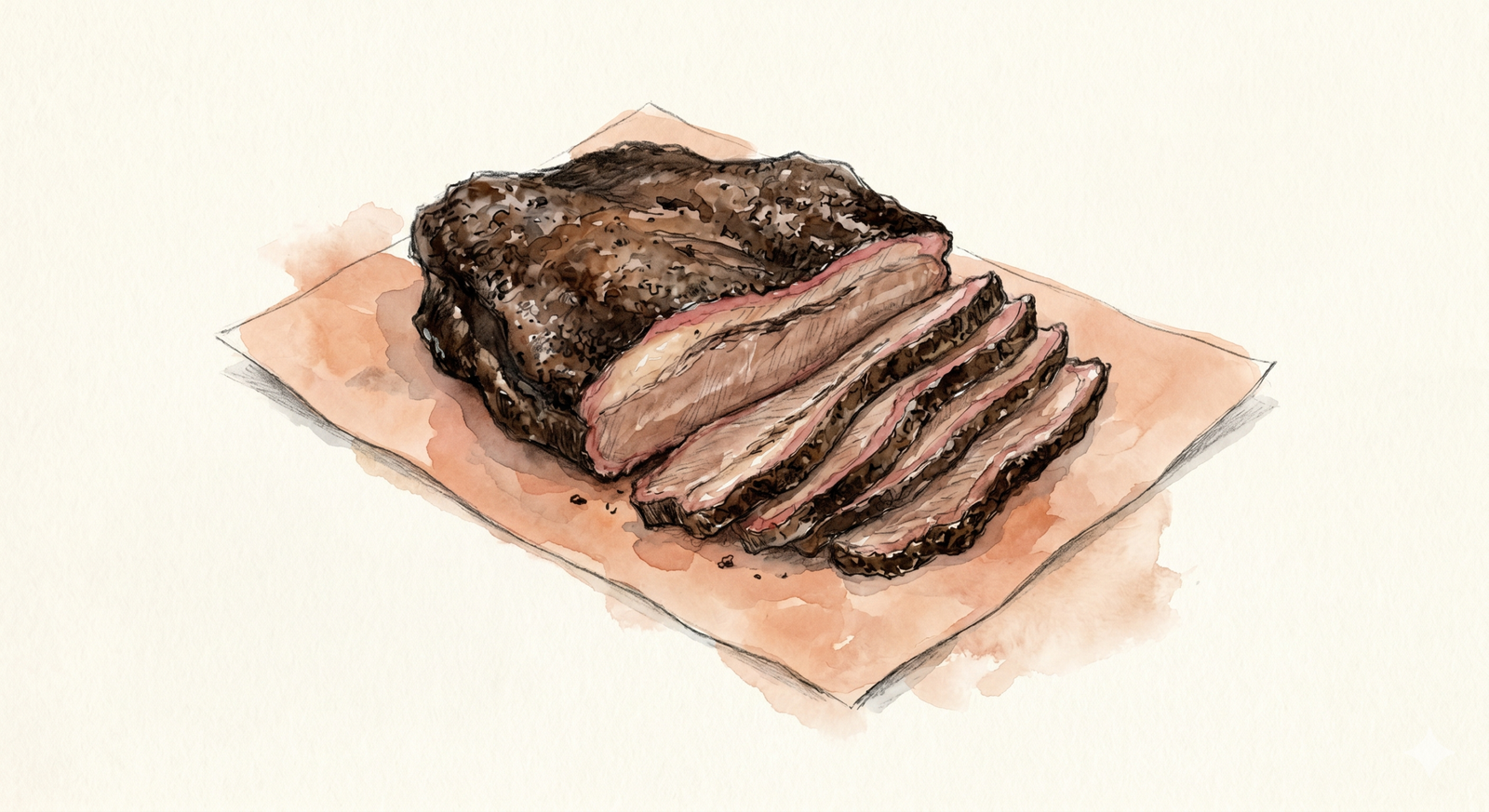
The smoke ring is the pink layer visible just inside the bark when a properly smoked brisket is sliced. It forms when nitrogen dioxide from burning wood reacts with myoglobin in the outer layer of the meat, producing a stable pink compound that does not change color when cooked. The reaction requires the meat surface to be moist enough to absorb the gas, which is why it forms in the early hours of the cook before the bark sets.
What the smoke ring tells you is that wood was burned and that the early cook produced enough surface moisture for gas absorption. What it does not tell you is how the brisket tastes. A deep smoke ring can exist alongside mediocre bark and underdeveloped interior flavor. Conversely, a thin ring does not indicate poor quality — certain cooking conditions, including pellet smokers, produce excellent brisket with a minimal ring.
The correct evaluation is the bark and the fat. A well-developed bark should be dark, crackling, and intensely flavored. The fat immediately beneath it should have rendered completely, creating a gelatinous layer between the bark and the meat. If the fat is still waxy or white in the cross-section, the brisket did not cook long enough regardless of what the smoke ring looks like.
What the Fat Cap Decision Tells You
A whole packer brisket comes with a fat cap — a layer of exterior fat on one side. Before the cook, the pitmaster trims it. How much they trim reveals their philosophy.
Leaving too much fat cap insulates the meat from smoke and heat, producing uneven cooking and a surface that never develops bark. Trimming it completely means losing the fat’s basting function — as the fat renders during the cook, it flows through the meat and keeps the interior moist.
Most serious Central Texas pitmasters trim to roughly a quarter inch: enough fat to baste the meat throughout the cook, not so much that it insulates against smoke penetration. That quarter-inch layer renders mostly transparent and gelatinous by the end of the cook, and the section directly under the fat cap is typically the most moist slice on the board.
How to Order Brisket in Texas
Order by the pound, not by the plate. Ordering by the pound means you see the cut and choose what you want. Ordering a plate means the cutter decides for you.
Ask for a mix of flat and point. At the counter, the Texas vocabulary is lean (flat) and moist or fatty (point). Use those words. The flat gives you even, clean slices. The point gives you the more intensely flavored, fattier pieces. If ordering flat only, ask for the fatty end — the end connected to the point. The thin, tapered far end of the flat is the piece most likely to be dry.
Sauce is available at most Texas BBQ operations and served on the side. Taste the brisket unsauced first. A brisket with properly developed bark and correct internal fat rendering does not need sauce. The sauce is there for the pieces that fell short, or for personal preference — not as a component of the dish.
Where to Eat
Lockhart, Texas — officially designated the Barbecue Capital of Texas by the state legislature in 2003, House Concurrent Resolution No. 5, a designation the town had earned long before the vote — has four operations that have run there for generations.
Kreuz Market has been operating since 1900: no forks, no sauce, meat served on butcher paper. The brisket is cooked in the original pits, and the shoulder clod — a cut rarely seen elsewhere — is worth ordering alongside it.
Smitty’s Market occupies the original Kreuz building after a family split in 1999. The pits in the back room are original and still wood-burning. The line forms in the pit room itself.
Black’s BBQ, opened in 1932, is the oldest family-owned BBQ restaurant in Texas. The beef rib is the dark-horse order — one of the best in the state.
Chisholm Trail BBQ rounds out Lockhart’s four: local-facing, less tourist traffic, the same approach for decades.
Franklin Barbecue in Austin established the national benchmark around 2009. USDA Prime beef, post oak, salt and pepper, fifteen-plus hours. Opens at 11am and sells out by early afternoon.
Snow’s BBQ in Lexington, Texas opens Saturday mornings at 8am. Owner Kerry Bexley runs the operation; pitmaster Tootsie Tomanetz, still active at the pits as of 2026 at age 90, is one of the most respected figures in Texas barbecue and among the last of a generation who learned the craft before it became a national conversation.
Louie Mueller Barbecue in Taylor, Texas has been operating since 1949 and is the model for the classic Central Texas barbecue hall: high ceilings, meat hooks, paper-lined trays, decades of smoke in the walls. The brisket here is leaner than Franklin’s, the bark is aggressive, and the overall character is older and more austere.
Texas BBQ Beyond Central Texas
East Texas BBQ is a wet tradition: beef cooked until tender and served chopped in a thick, sweet tomato-based sauce. The influence is closer to Southern soul food than to Hill Country pitmasters. It is a legitimate regional form that predates the national interest in Central Texas and is underrepresented in the national BBQ conversation.
South Texas BBQ is influenced by northern Mexican barbacoa traditions — traditionally beef cheeks cooked low and slow, migrated into mainstream Texas weekend breakfast culture and served in tacos on Sunday mornings at taquerias across the state.
West Texas BBQ uses mesquite rather than post oak, producing a stronger, more assertive smoke with a slightly bitter edge. Mesquite burns hotter, requires more careful management, and produces a distinctly different finished product. Less nationally known but genuinely distinct.
What to Skip
Any operation calling itself Texas BBQ that cooks with gas or electric is not producing what this piece describes. Pellet smokers — which burn compressed wood pellets rather than logs — have improved significantly and modern high-end units can produce meaningful smoke rings, but the combustion profile differs from open-fire wood burning and the result is a different product. Gas ovens produce no smoke chemistry at all.
Brisket that arrives pre-sliced and sitting in its own juices has been resting cut-side down, which accelerates moisture loss and softens the bark. The correct method is to slice to order from a whole brisket resting intact since coming off the pit. Pre-sliced, pooled brisket tells you the kitchen is managing volume over quality.
How to Think About Texas Brisket: The Transferable Framework
Three questions in sequence. First: what does the bark look like? Dark, crackling, and intact means the cook was long enough and the surface dried correctly. Soft, pale, or wet means it was not. Second: what does the fat look like in the cross-section? Rendered clear and gelatinous means the cook went long enough for collagen conversion. Waxy or white means it did not. Third: what wood was used, and how does the smoke register on the palate? Post oak is mild and complementary. Hickory is assertive. Mesquite is strong with a bitter edge.
Those three questions apply to every brisket you eat anywhere. The Central Texas tradition defines the benchmark because it is the most stripped-down form — no sauce, no complex rub, nowhere to hide. The brisket either justifies the confidence the cook placed in the beef, the wood, and the time. Or it does not.