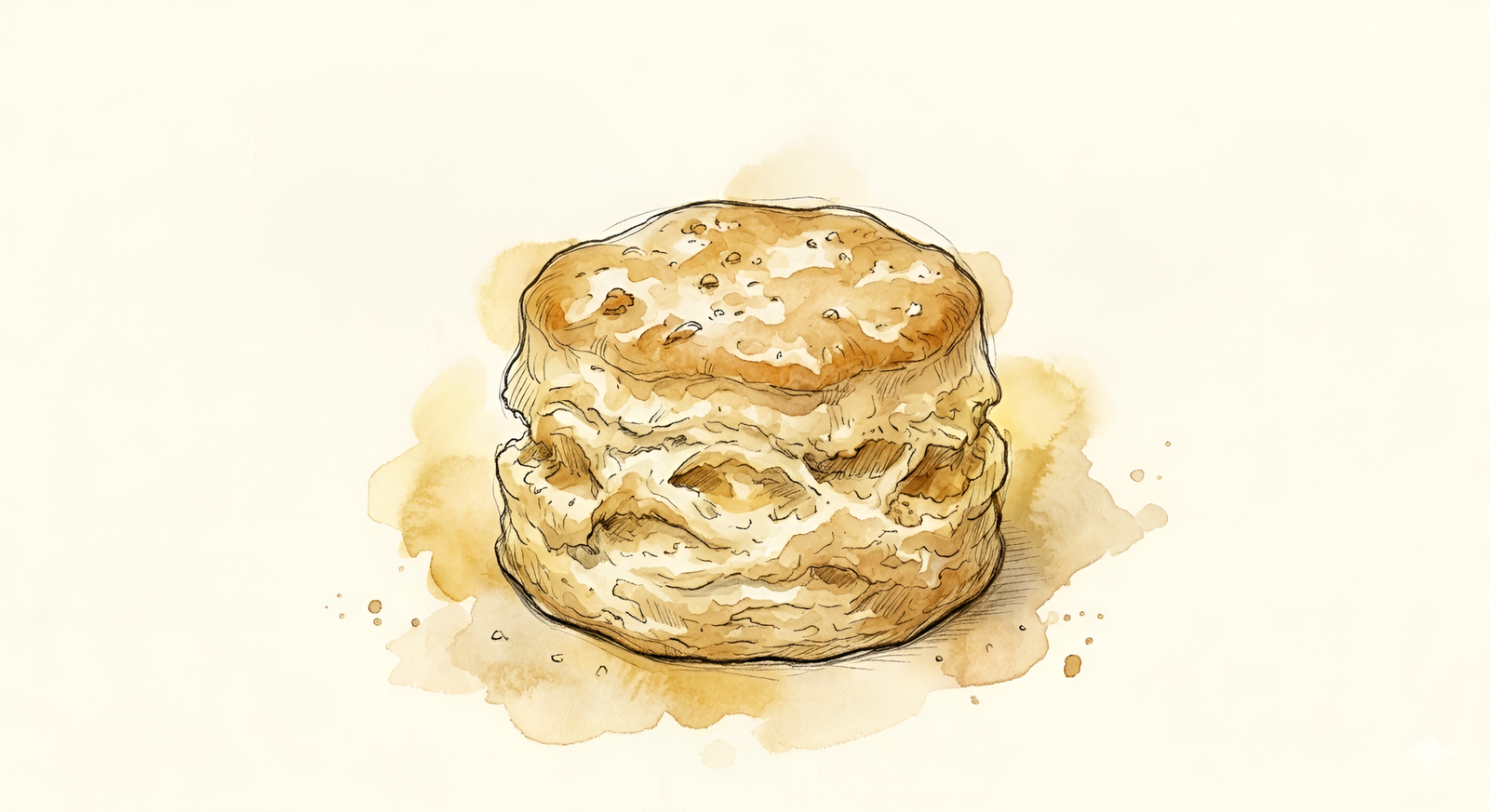
The Southern Biscuit Guide
The best Southern biscuit is not the tallest one, or the flakiest one, or the one made with the most butter. The best Southern biscuit is the one built for its intended purpose — and purpose is what most biscuit conversations skip entirely. A biscuit meant to stand alone with butter and sorghum needs an entirely different structure than one meant to hold a fried chicken thigh and hot sauce. Judging them by the same standard is the wrong argument.
The Best Biscuit Is the One Built for Its Job
Every decision in a biscuit — the flour, the fat, the liquid, the handling method, the size — is a response to what the biscuit needs to do. A tall, tender, pull-apart biscuit with delicate layers is a specific engineering achievement, optimized for eating with your hands and a knife spread with butter. Load it with a runny egg and a thick slice of country ham, and it falls apart before the second bite. That is not a failure of the biscuit. That is a mismatch between the biscuit and the job.
Understanding that framework changes how you evaluate every biscuit you encounter. The question is never which biscuit is best. The question is what this biscuit was built to do, and whether it does it.
The Standalone Biscuit: Built for Butter
The biscuit most people picture when they think Southern is the tall, layered, tender version — open crumb, slight tang from buttermilk, exterior that browns to a pale gold without hardening. This biscuit is designed to be eaten on its own, split and buttered, or dipped in sorghum or cane syrup.
Its structure depends on a few specific decisions. White Lily flour — milled from soft winter wheat grown in the South, with a protein content around 8 to 9 percent compared to 10 to 12 percent in all-purpose flour — produces less gluten development with the same handling, which is why Southern biscuits made with it are more tender than those made with Northern flour. Cold fat cut into the flour in distinct pieces creates steam pockets during baking, producing visible layers. Minimal handling keeps those pockets intact. Buttermilk provides the acid that reacts with baking soda for lift and a slight tang that keeps the biscuit from tasting bland.
This biscuit does not need to be structural. It needs to be worth eating on its own. It also needs a hot oven — 425 to 450 degrees — to flash the water content in the cold fat into steam fast enough to lift the layers before the dough sets. Drop the temperature, and the steam dissipates gradually instead, producing a biscuit that spreads rather than rises.
The Sandwich Biscuit: Built to Hold
A biscuit carrying bacon, egg, and cheese — or a fried chicken thigh, or pulled pork — needs to function as a container. The filling adds weight, moisture, and in many cases fat, all of which a too-tender biscuit cannot manage. It splits at the wrong seam, soaks through, or compresses under the filling into something closer to bread pudding than a sandwich.
The sandwich biscuit solves this with slightly more structure: a higher-protein flour than White Lily, or more working of the dough to develop some gluten, or a fat with a higher melting point that produces a denser crumb. The biscuit Bojangles built its franchise around is a sandwich biscuit — sized generously, sturdier than a standalone butter biscuit, with a crust that can take the weight of a bone-in chicken piece without losing its shape.
Neither version is better. They are solving different problems.
The Cathead Biscuit: Built for the Plate
The cathead is a drop biscuit — mixed wet enough that it falls from a spoon or an ice cream scoop rather than being rolled and cut. It is named for its size, roughly that of a cat’s head, and it is the working biscuit of the Deep South, the one that appears on a plate lunch next to a bowl of sawmill gravy or a pot of field peas with pot likker.
Its purpose is absorption and presence. The open, rough crumb that would make a cathead a poor candidate for a sandwich makes it ideal for sopping — the uneven surface area catches liquid, the larger size holds heat, and the texture holds up to a bowl of something wet without dissolving. The technique is faster than a rolled biscuit, which is partly why it persisted in home and restaurant kitchens where biscuits were made daily and efficiency mattered.
A cathead biscuit judged against a tall, layered standalone biscuit will lose. That comparison tells you nothing useful.
The Beaten Biscuit: A Different Category Entirely
The beaten biscuit is not a leavened biscuit. It predates baking powder, predates reliable baking soda, and predates the entire framework of the fluffy Southern biscuit most people mean when they use the word. It is made by working the dough aggressively — historically beaten with a mallet or a rolling pin for twenty minutes or more — which develops gluten and incorporates air through physical force rather than chemical leavening. The result is dense, dry, crisp, and nearly crackerlike.
Its purpose is different from every other biscuit on this list: it is a vehicle for country ham. The beaten biscuit does not compete with the ham. It holds it, frames it, and provides a texture that makes the salt and fat of a thin-sliced cured ham make sense as finger food. It is common at Virginia and Maryland tables and at Southern events where standing and eating is the format. Served warm at a cocktail party with a piece of Surry County ham, it is exactly right. Served at breakfast in place of a butter biscuit, it is exactly wrong.
Why White Lily Flour Is Not Just a Brand Preference
White Lily is not interchangeable with all-purpose flour in a Southern biscuit recipe, and the difference is not subtle. Soft red winter wheat — the variety grown across the South and milled into White Lily — has a lower protein content than the hard wheat grown in Northern and Midwestern states. Lower protein means less gluten formation with the same amount of handling, which means a more tender crumb with less risk of toughening the dough.
This is why recipes developed in Southern kitchens using White Lily do not produce the same results when made with King Arthur or Gold Medal all-purpose flour. The flour is not a stylistic preference. It is a regionally specific ingredient with different structural properties, and using a substitute without adjusting the recipe treats it as though it were.
One additional factor that rarely gets mentioned: White Lily is chlorine-bleached, and the bleaching does more than whiten the flour. The process slightly damages the starch granules and raises the flour’s acidity, which allows fat to distribute more evenly through the dough and helps the biscuit rise more quickly. It is part of why unbleached all-purpose flour, even at a similar protein level, does not fully replicate what White Lily produces. The bleaching is doing structural work, not cosmetic work.
White Lily is available nationally now, but for most of its history it was a Southern-only product. The biscuit tradition built around it developed in the same region where the wheat grew. That is not a coincidence.
The Fat Argument: Lard, Butter, and Shortening
Fat choice is where biscuit arguments get loudest and where purpose matters most. Each fat produces a different result, and none of them is universally correct.
Lard produces the most distinct layers in a rolled biscuit. Its higher melting point keeps the fat solid longer in the oven, creating more defined steam pockets and a flakier crumb. Lard biscuits have a mild, savory flavor that reads as neutral against both sweet and salty toppings. Appalachian biscuit tradition leans heavily on lard, and the results justify it.
Butter produces a richer flavor and a more golden exterior but melts faster during baking, producing a less layered crumb. A butter biscuit eaten warm with more butter is one of the better arguments for a standalone biscuit. The same biscuit as a sandwich vehicle, where the fat content of the filling is already high, can read as too rich.
Shortening produces a very tender, consistent crumb with neutral flavor and little browning. It was the standard in institutional and fast-food biscuit making for decades because it is forgiving and predictable. The biscuit it produces is soft but lacks the flavor complexity of lard or butter. Many serious biscuit makers use a combination — lard or shortening for structure, butter for flavor. The ratio is the argument.
The Framework: Start With the Job
Before you evaluate any Southern biscuit, ask what it was built to do. Is it a standalone biscuit — meant to be eaten with butter, sorghum, or jam, with nothing required of it structurally? Is it a sandwich biscuit — built to hold a filling without collapsing under moisture and weight? Is it a cathead — built for presence and absorption on a plate alongside something wet? Is it a beaten biscuit — built to carry country ham at a standing occasion where the biscuit is not the point?
Once you know the job, you know the standard. A biscuit that does its job well is the best biscuit. The flour, the fat, the technique, and the size are all downstream of that first question.