Austin Breakfast Tacos: How to Order Them Like You Live There
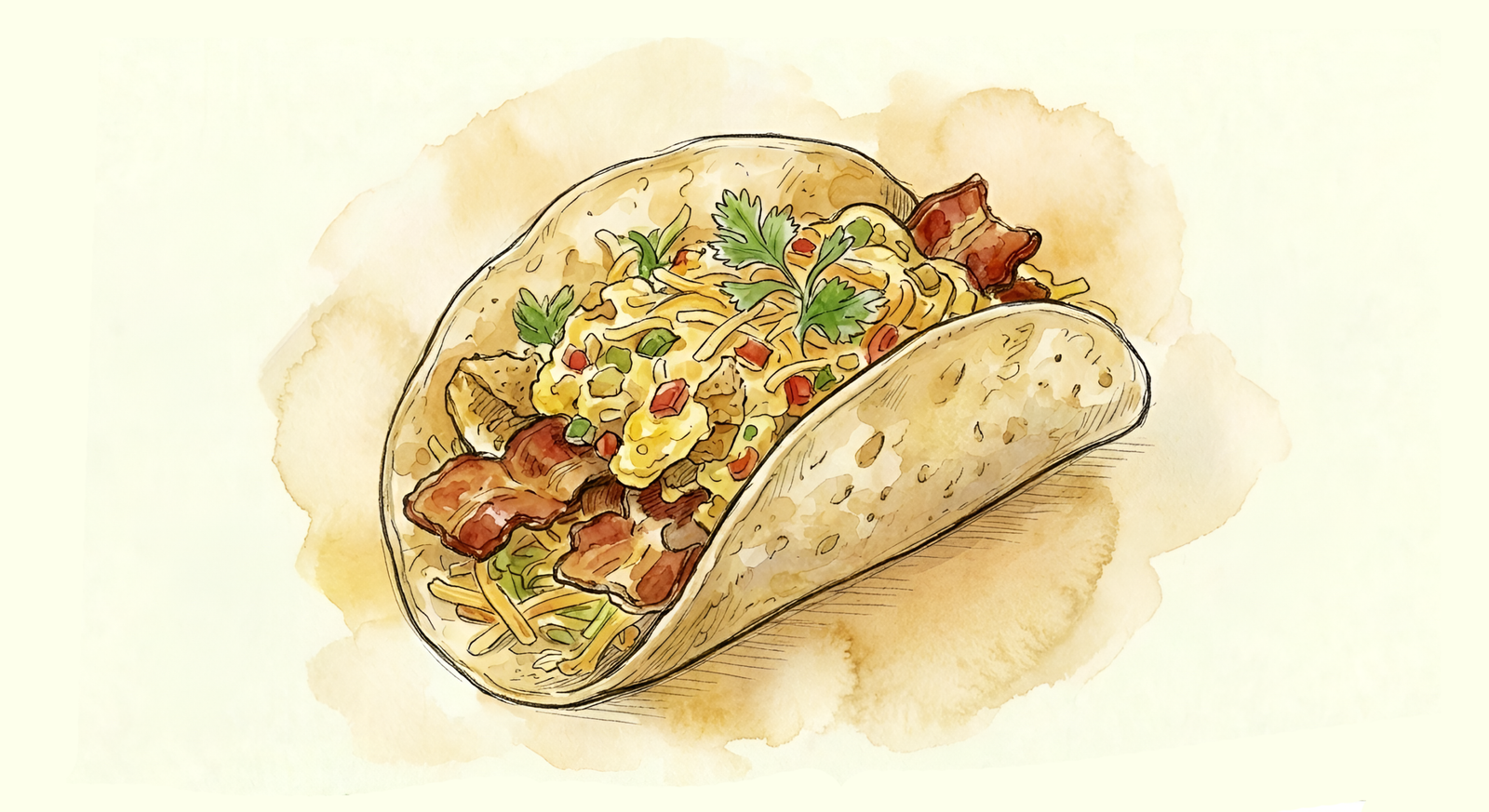
Austin breakfast tacos are not a trend and they are not brunch. They are a working-class morning tradition rooted in the Mexican-American communities of South Texas, evolved through Austin’s specific taqueria culture over decades, and now subject to a level of national attention that has complicated the original simplicity without improving it. The correct breakfast taco costs between two and four dollars. It is made on a fresh flour tortilla. It has enough filling to require two hands and enough hot sauce to count as condiment. It is eaten before 10am, ideally before 9, and preferably standing at a counter or sitting on a tailgate. The experience deteriorates in direct proportion to how much you plan it.
The San Antonio Question: Who Owns the Breakfast Taco
Austin did not invent the breakfast taco and the city sometimes behaves as if it did.
The breakfast taco — eggs, beans, or meat folded into a tortilla and eaten in the morning — is a South Texas tradition that predates Austin’s claim by generations. San Antonio’s Mexican-American community was eating tacos for breakfast long before Austin’s food culture was nationally visible. The Rio Grande Valley and border communities have maintained the tradition without interruption since before it had a name.
What Austin did was amplify and export the breakfast taco into mainstream American food culture. The city’s combination of a large university, a transplant population with money and appetite, and a Mexican-American taqueria infrastructure that had always been there produced the conditions where breakfast tacos became visible to people who had not grown up eating them. Austin popularized the format nationally. It did not originate it.
The best Austin breakfast tacos are not at the places that showed up in national food media after 2010. They are at the family-run taquerias that were making them for construction crews and early shift workers before anyone wrote about them. Those places are still there.
The Tortilla: Why Flour Beats Corn for This Specific Application
Most serious Tex-Mex arguments eventually arrive at corn tortillas as the more traditional choice. The breakfast taco is the exception where flour is correct, and the reason is structural.
A fresh flour tortilla is soft, slightly stretchy, and able to hold a warm, moist filling without tearing or becoming soggy at the contact point. Eggs create steam inside the taco after it is folded. A flour tortilla handles that steam and remains intact. A corn tortilla — especially a thinner one — begins to fall apart at the fold when it meets hot, wet scrambled eggs.
Tortilla quality is the most reliable indicator of whether a taqueria is worth ordering from. A flour tortilla made fresh on a comal that morning has a specific quality: slightly charred in spots, soft and pliable, with a faint wheat flavor and structural integrity that holds up through the taco. A pre-made tortilla has uniform color, a slightly waxy texture, and a tendency to tear at the fold. Ask whether the tortillas are made in house. Tortillas made fresh on a comal are the answer you are looking for.
What to Order: The Core Fillings
Potato and egg is the foundation order. Crispy diced potatoes with scrambled egg is the most classic Austin breakfast taco filling, and the one that most clearly reveals the kitchen’s quality. If the potatoes are crispy on the outside and cooked through, the kitchen is paying attention. The ratio matters: roughly equal parts potato and egg, with enough egg to bind the potato into a cohesive filling.
Migas is the Austin-specific egg preparation worth understanding. Scrambled eggs cooked with fried corn tortilla strips, onion, jalapeño, and tomato — sometimes with cheese. The tortilla strips absorb some of the egg while maintaining a slightly crispy texture, producing an egg dish with more complexity than a straight scramble. A migas taco is the most specifically Austin preparation on any breakfast taco menu.
Barbacoa is the Sunday morning order. Beef cheeks braised overnight until they fall apart, piled into a tortilla with onion and cilantro. Barbacoa is not an everyday filling — the production is too labor-intensive for daily batches — and when it runs out, it runs out. Showing up at 9am on a Sunday for barbacoa is showing up at the right time. Showing up at 11am is showing up to be disappointed.
Bean and cheese is the sleeper order that most non-locals overlook. Refried beans and shredded cheese on a fresh warm tortilla is a two-dollar argument that the simplest things are often the best things.
Chorizo and egg: Mexican-style fresh chorizo — not the dried Spanish kind — adds fat and spice that carries through the egg in a way that makes it one of the stronger meat options on the menu.
The Hot Sauce Question
Salsa verde — tomatillo-based, slightly sharp, bright green — is the correct sauce for migas and potato and egg. The acidity cuts through the richness of the egg without competing with it.
Red salsa works better with meat fillings, particularly barbacoa and chorizo, where you want something with more body and heat that complements the fat in the protein.
If the taqueria makes its own salsa, use it. A house salsa is the kitchen’s argument about flavor, and it almost always tells you something about the taqueria’s seriousness.
The Time Window
Breakfast tacos are a morning food. The window is roughly 6am to 10am, and the quality of the experience is better at 7am than at 9am, and meaningfully better at 9am than at 10:30am.
The practical reason is freshness: tortillas made early in the morning are at their best in the first hours. Fillings — especially potatoes — hold texture better early in the service when batches are fresh rather than sitting in a pan.
The cultural reason is that breakfast tacos are a working-person’s morning meal, and the authentic experience of them is tied to that morning context. A breakfast taco eaten at 7:30am in a taqueria where the parking lot has trucks with tool racks and the coffee is mediocre and nobody is on their phone tastes like Austin. A breakfast taco eaten at 11am in a restaurant that has pivoted to brunch service tastes like a breakfast taco.
Where to Go
Veracruz All Natural — multiple locations around Austin, founded by sisters Reyna and Maritza Vazquez — is the most nationally known Austin breakfast taco operation. The migas taco, made with fresh corn tortilla chips, eggs, pico, jalapeño, and cheese, is the dish that put Austin breakfast tacos on the national map. The Webberville Road location is the flagship. The tortillas are made fresh. The lines are real. Arrive early. In 2026 the Vazquez sisters expanded into a new concept called Diablo Hot Chicken — worth noting because it signals what Austin’s next food conversation looks like, built by the same operators who defined the last one.
Juan in a Million on East Cesar Chavez is the old-school East Austin institution. The Don Juan taco — a massive flour tortilla loaded with eggs, potato, bacon, bean, and cheese — is a local reference point for excess done correctly. Juan Meza opened the place in 1980; his son Juan Jr. now handles day-to-day operations, but the handshake-with-every-customer tradition is intact. The room is a community document: photos and memorabilia covering every surface, regulars who have been coming for thirty years.
Joe’s Bakery and Coffee Shop on East 7th has been an East Austin institution since 1962, run by the Avila family. The breakfast tacos are straightforward and correct, the flour tortillas are made in house, and the coffee is old-school diner coffee that is part of the experience. A 2025 MICHELIN Guide recognition confirmed what the neighborhood already knew. This is the version that existed before Austin became a food destination.
Tyson’s Tacos on Airport Boulevard is a smaller, less celebrated operation that the locals who know it treat as a benchmark and a reliable alternative when the better-known spots have lines. The potato and egg is the order.
Valentina’s Tex Mex BBQ has moved its primary operation to Buda, just south of Austin — worth confirming before you drive to the old Manchaca Road location. The Real Deal Holyfield taco, which puts brisket in a breakfast taco context, remains the signature order and makes a genuine argument about what Austin’s food culture is in 2026.
What to Skip
Any breakfast taco where the tortillas are pre-made and heated on a griddle has already made its most important concession. No filling quality compensates for it.
Any breakfast taco priced above six dollars is asking you to pay for the experience of eating a breakfast taco rather than the taco itself. The format is not luxury food. Its value is in the fact that it is cheap, fast, and good. The moment it becomes an occasion, something has been compromised.
How to Think About Austin Breakfast Tacos: The Transferable Framework
Three questions establish whether a breakfast taco is worth eating. First: are the tortillas made fresh today? If yes, the kitchen is paying attention to the most important element. Second: what does the filling taste like on its own? A filling that tastes flat does not improve with hot sauce. Third: what does the taco cost? A taco priced at the working-person rate — under four dollars — is a taco operating in the tradition that produced it.
The best Austin breakfast taco is not at the place you read about first. It is at the place that has been making tacos for the construction crew that shows up at 6am, which may or may not be the same place, but which is always the right standard to measure against.