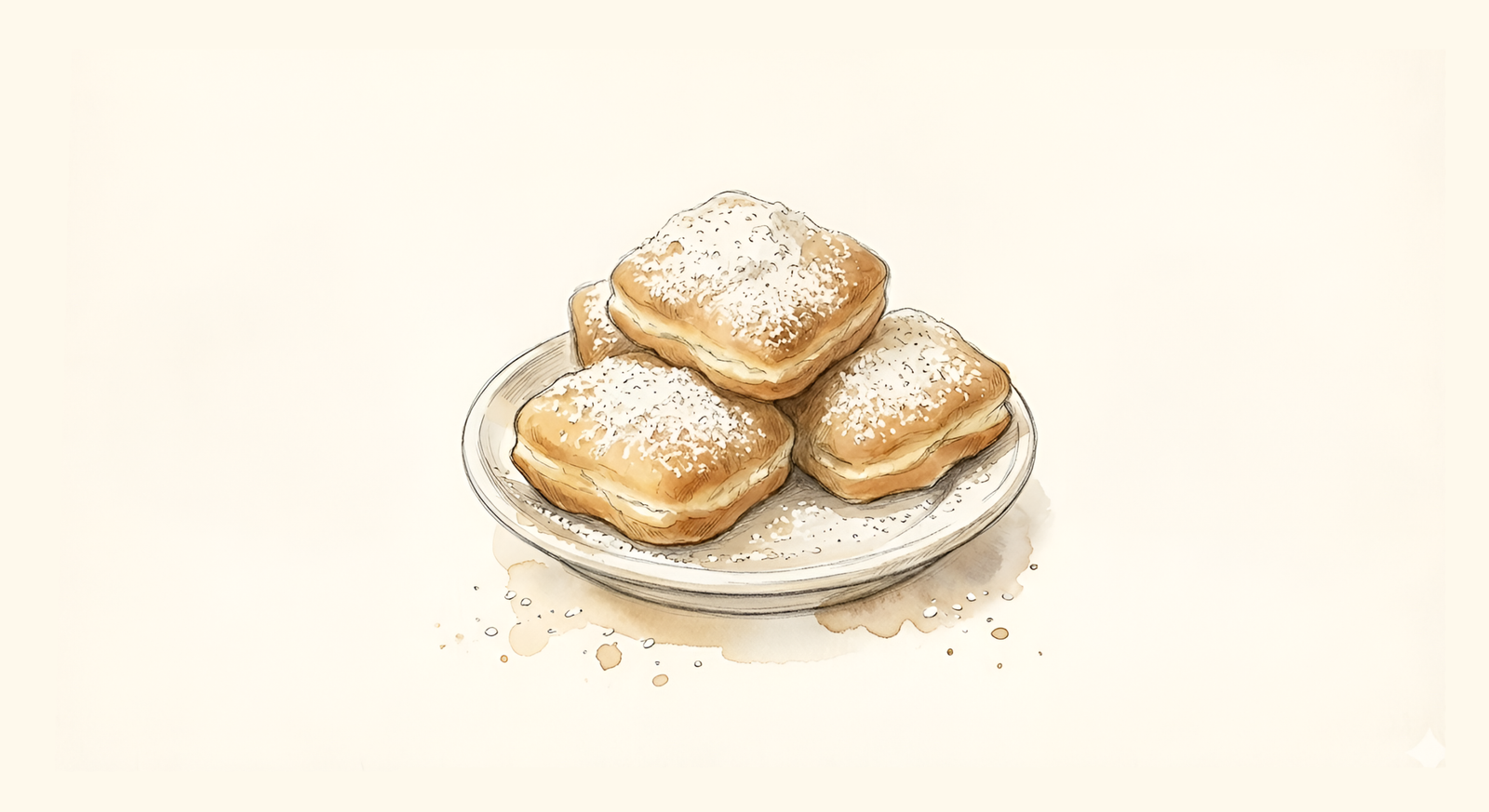
Cafe Du Monde Is the Reference Point. It Is Not the End of the Conversation.
Most people who eat a beignet in New Orleans eat it at Cafe Du Monde, which is the correct starting point. The problem is that most people stop there. Cafe Du Monde is the reference point for the tradition — the open-air counter, the powdered sugar avalanche, the chicory cafe au lait — and understanding why it occupies that position is worth more than simply queueing for it. What it does, it does consistently and well. What it does not do is represent the full range of what a beignet can be in this city, and a visitor who leaves New Orleans having eaten only Cafe Du Monde beignets has understood one sentence of a longer argument.
What a Beignet Actually Is
A beignet is fried dough, square-cut and served hot, buried under a quantity of powdered sugar that is not a garnish but a structural component of the eating experience. The name is French and the tradition arrived in New Orleans with French colonial settlers, reinforced by the Ursuline nuns who brought their frying traditions from France in the early eighteenth century. New Orleans absorbed the beignet into its cafe culture and kept it there across three centuries of political change, culinary evolution, and hurricane damage. The dish is older than the United States.
What distinguishes a beignet from a donut is the dough and the absence of a hole. Most New Orleans beignets are made from yeast-leavened or choux-style dough — lighter and more airy than donut dough — fried until the exterior is just set and the interior remains soft and slightly custardy. The powdered sugar is applied in a quantity that seems excessive and is actually precisely correct: it creates a sweet exterior crust that moderates the heat of the fried dough and provides textural contrast between the sugared surface and the soft interior. Trying to eat a beignet delicately, avoiding the powdered sugar cloud, is the wrong approach. You will wear some of the sugar. This is part of the meal.
Cafe Du Monde: What It Is and What It Is Not
Cafe Du Monde opened in 1862 in the French Market and has been making the same three items — beignets, cafe au lait, and orange juice — since before anyone alive was born. The operation is outdoor seating under a green-and-white awning, with a long tradition of late-night and early-morning hours that made it a New Orleans institution for both insomniacs and early risers. Hours have varied since the pandemic — confirm current hours before planning a 2am visit — but the spirit of the place runs around the clock. The consistency is architectural.
What Cafe Du Monde does: it produces a technically correct beignet, at volume, consistently, at any hour. The cafe au lait made with chicory coffee and hot steamed milk is the correct pairing, and the relationship between the bitter, roasted depth of the chicory and the sweetness of the fried dough and sugar is not accidental. It is a flavor combination that developed in tandem over generations of New Orleans breakfast culture.
What Cafe Du Monde does not do: it does not represent the creative range of what a beignet can be. And it exists, increasingly, within a tourist corridor that can make the experience feel more like a theme park attraction than a breakfast counter. None of that diminishes the beignet itself. The beignet at Cafe Du Monde is good. The experience around it varies depending on when you go.
The correct time to go is 2am or 7am. Not 11am on a Saturday.
The Chicory Coffee Pairing: Why It Works
Chicory cafe au lait is not an optional pairing with beignets. It is the pairing, developed alongside the dish over the same centuries, and the flavor logic is exact.
Chicory — the roasted root of Cichorium intybus — was first added to coffee in France during the Napoleonic era, when the Continental Blockade of 1806 disrupted coffee imports and the French began extending their supply with chicory root. The French brought the habit to Louisiana with them. The Civil War Union blockade a half-century later made it a permanent necessity in New Orleans specifically, cementing chicory coffee as a local institution rather than a wartime workaround. Community Coffee and Cafe Du Monde’s own branded blend are the two most common chicory coffees in the city.
The cafe au lait preparation — equal parts strong chicory coffee and hot steamed whole milk — moderates the bitterness while maintaining its flavor presence. Against a beignet covered in powdered sugar, the bitter-roasted depth of the chicory cuts through the sweetness in exactly the way that Crystal hot sauce cuts through the fat of a dressed po’boy. The pairing is not a coincidence. It is two centuries of calibration.
Ordering beignets with regular drip coffee, or without coffee at all, is a category error. The combination is the dish.
Beyond Cafe Du Monde: Where the Conversation Continues
Morning Call is the other institution — and the older one, founded in 1870. After decades near the French Market and a stint in City Park, Morning Call now operates at 5101 Canal Boulevard, near the cemeteries on the edge of Mid-City. The beignets are made from a slightly different dough producing a marginally denser result. The Canal Boulevard location skews local rather than tourist. If you want the beignet without the performance, this is the version worth seeking.
Loretta’s Authentic Pralines on N. Rampart Street — with a stall in the French Market as well — makes a sweet potato beignet that represents the most significant creative evolution of the form in the city. The dough incorporates sweet potato, producing a slightly denser, earthier result with a sweetness that comes from the vegetable rather than only the sugar coating. The shop was founded by Loretta Harrison, who passed away in 2022; the Harrison family continues her legacy. The sweet potato beignet is the product most worth making a trip for if you want to understand what else the format can do.
Cafe Beignet has multiple French Quarter locations and a broader menu than Cafe Du Monde. The beignets are competent and the access is easier than the Cafe Du Monde line on a busy afternoon. Not the reference point, but a functional alternative.
La Boulangerie on Magazine Street approaches the beignet from a French patisserie perspective, using a choux-based dough that produces a lighter, more hollow interior. If you want to understand the French pastry tradition the New Orleans beignet descended from, this is the version that illuminates it.
The 2am Argument
Cafe Du Monde is open at 2am with the same menu, the same dough, the same chicory coffee. The crowd at that hour is different: fewer tourists, more locals, more people who have been doing other things that evening and need something warm and sweet before going home.
A beignet at 2am tastes different from one at 10am, and not only because of the occasion. The dough is the same. The powdered sugar is the same. What changes is what you are eating it against and what you need from the meal. Go once at a normal hour and once at an unreasonable one. The comparison is worth making.
What to Skip
Any beignet not served immediately from the fryer has lost its primary quality. The exterior sets as it cools and the interior compresses. If you order to go in a paper bag, the steam inside turns the powdered sugar into a paste within minutes. The correct move is to eat them immediately at the counter or at a table — not to carry them somewhere first. The paper bag is not a to-go container. It is a countdown clock.
Any beignet outside New Orleans that calls itself authentic should be approached with skepticism. The dough recipe can travel. The chicory coffee culture, the open-air setting, the specific New Orleans context that frames the experience does not.
How to Think About Beignets: The Transferable Framework
Two things determine the quality of a beignet: the dough and the timing. A yeast dough produces a light, airy interior; choux produces a lighter, more hollow result. Neither is more correct. But the dough has to be fresh and the frying has to be immediate. A beignet evaluated ten minutes after it was made is not being evaluated at its best.
The powdered sugar is not optional. The chicory coffee is not optional. Both are structural to the experience. Ordering beignets without chicory cafe au lait is possible. It is also missing the point of how New Orleans built this meal.
Go to Cafe Du Monde first. Understand the reference. Then find Loretta’s sweet potato beignet, or Morning Call in City Park, or La Boulangerie’s choux version. The conversation between those four experiences tells you more about what New Orleans does with fried dough than any single visit to any single counter.