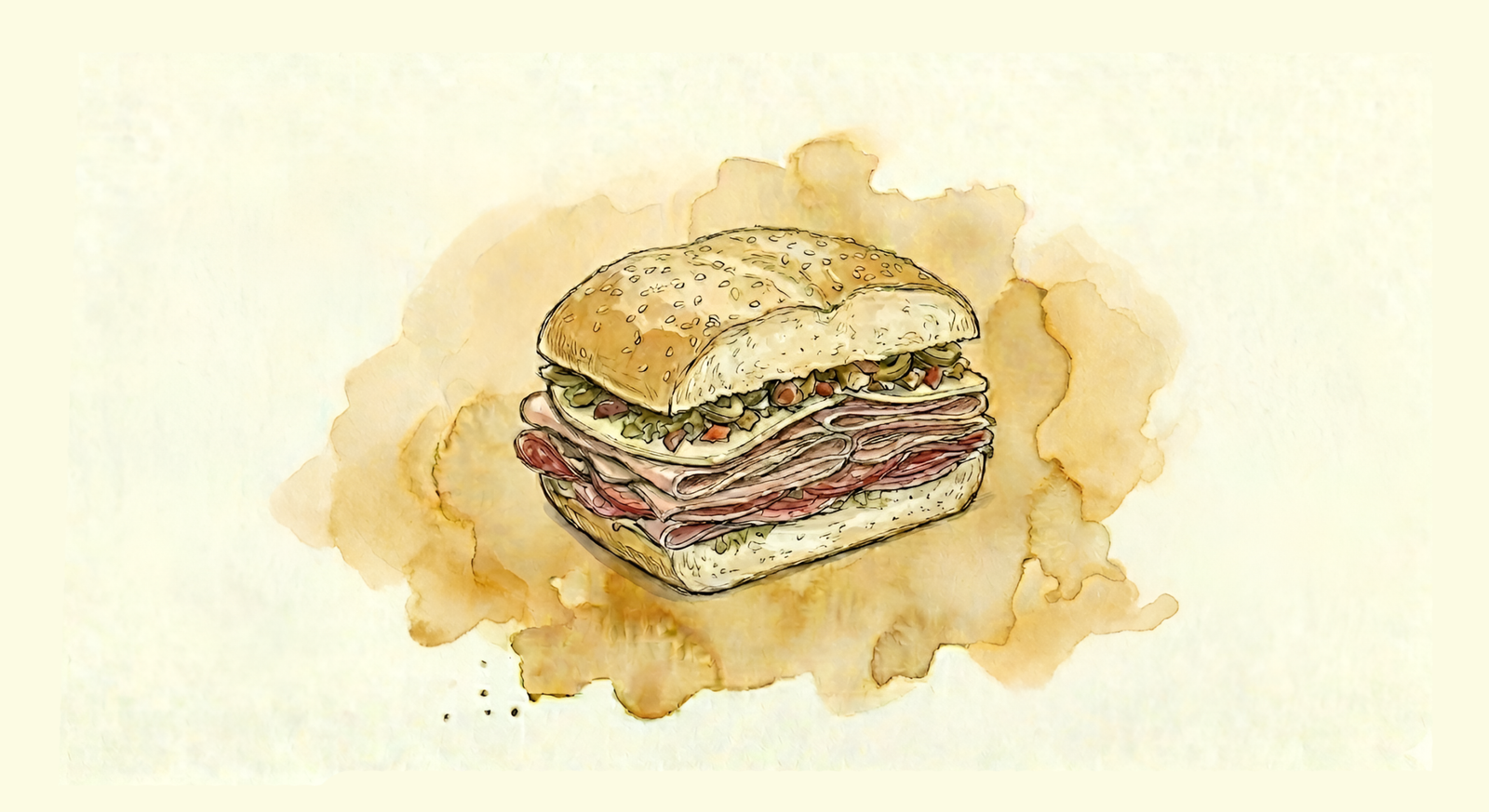
The Po’boy Gets the Press. The Muffuletta Is What New Orleans Actually Eats.
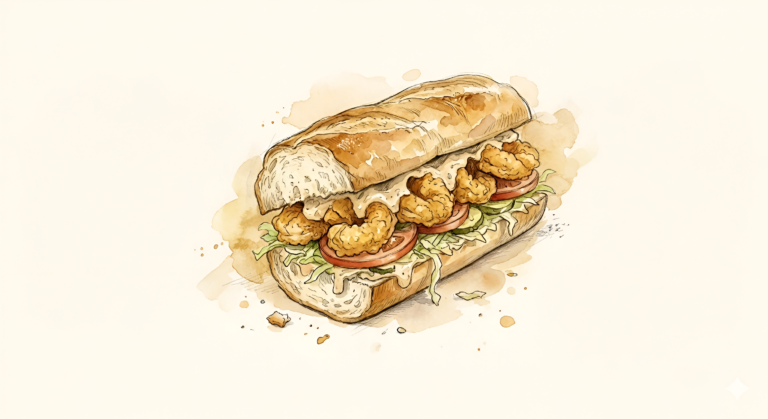
Every serious conversation about New Orleans sandwiches leads to the po’boy, which is the correct starting point and the wrong ending point. The po’boy is the bread argument — a piece about what happens when a specific loaf engineered for a specific filling becomes inseparable from the tradition it created. The muffuletta is a different argument entirely: it is about what happens when a specific immigrant community builds a specific market in a specific city and creates a dish from the ingredients they brought with them and the hunger of the workers they were feeding. The olive salad at the center of a muffuletta does not exist anywhere else in the same form. Neither does the sandwich.
Why the Muffuletta Exists in New Orleans and Nowhere Else
In the late nineteenth and early twentieth centuries, New Orleans received one of the largest Sicilian immigrant populations of any American city. By 1900, Italians — mostly Sicilians — were the largest foreign-born ethnic group in the city. They came through the port, settled in the French Quarter and adjacent neighborhoods, and established the city’s produce markets, grocery trade, and street vending networks. The area around the French Market became known as Little Palermo. The olive oil, cured meats, and pickled vegetables of Sicilian cuisine arrived with them and became embedded in New Orleans food culture in ways that have never fully separated from it.
Central Grocery on Decatur Street was opened by Salvatore Lupo in 1906. It was an Italian import grocery — olive oil, canned goods, cured meats, cheeses, the specific preserved vegetables that Sicilian cooking requires. The workers who came to the market needed lunch. The story passed down through the Central Grocery family is that Lupo watched these workers eating their components separately — bread in one hand, olives in another, meat in a third — and assembled everything into a single sandwich on the round Sicilian sesame loaf they called a muffuletta. Whether that origin story is precisely accurate in every detail, what is true is that Central Grocery has been making muffulettas on the same block since 1906, and the sandwich has not fundamentally changed.
The muffuletta is not an Italian sandwich that traveled to New Orleans. It is a New Orleans sandwich built from Italian ingredients by an Italian immigrant community in a specific time and place. The olive salad was developed here, from the preserved vegetables and olives available at that specific grocery, for the purpose of making this specific sandwich. That is why it is irreducibly New Orleans rather than simply Italian-American.
The Olive Salad: Why This Is the Whole Point
The olive salad is what separates a muffuletta from any other Italian-American sandwich, and it is what most imitations outside New Orleans get wrong or omit. It is not a condiment. It is not a topping. It is the structural and flavor center of the sandwich, and without a properly made olive salad, the thing in your hands is not a muffuletta in any meaningful sense.
A Central Grocery-style olive salad contains green and black olives, giardiniera vegetables — pickled cauliflower, carrots, celery — pepperoncini, cocktail onions, capers, garlic, and olive oil. The vegetables are roughly chopped and marinated together, the olive oil carrying the flavors of everything into a unified brine that soaks into the bread during the resting period. The acidity of the pickling liquid, the fat of the olive oil, the salt of the olives and capers, and the heat of the pepperoncini produce a flavor combination that is simultaneously preserved, briny, sharp, and rich.
That olive salad is applied in a quantity that would seem excessive on any other sandwich: a thick layer across the entire cut surface of the loaf before the meats go on. More olive salad than you think is correct is usually about right. By the time the sandwich has rested, the olive oil and brine have penetrated the bread’s crumb and changed it from a neutral carrier into a seasoned, slightly soft surface that is part of the flavor structure rather than just a container for what is inside.
The Bread: What Makes a Muffuletta a Muffuletta
The muffuletta loaf is a large, round, flat Sicilian sesame bread — roughly ten inches in diameter, about two inches tall, with a tender crumb and a crust that has some structure but is far softer than New Orleans French bread. It is sliced horizontally and loaded from the inside out: olive salad first, then meats and cheese, then more olive salad on the top half. In New Orleans, the loaf is primarily supplied by United Bakery and Alois J. Binder — local bakeries that produce the sesame round specifically for this purpose. Outside the city, the bread is the hardest element to replicate. Focaccia in particular is too oily and soft; it dissolves under the olive salad rather than absorbing it with any structure.
The round format means no bite is all-crust-and-filling-edge the way a long sandwich inevitably produces at the ends. Every cross-section of a properly made muffuletta contains the same ratio of bread, olive salad, and filling. The softness of the crumb — compared to the shattering crust of po’boy bread — is what allows the olive oil to penetrate. Po’boy bread is engineered to maintain structural contrast with its filling. Muffuletta bread is engineered to absorb and integrate.
The sesame seeds are part of the flavor, not decoration. The nuttiness of toasted sesame on the crust reads against the acidity of the olive salad in a way that plain bread would not produce.
The Meats: What Goes on a Traditional Muffuletta
The traditional filling is Genoa salami, ham, mortadella, provolone, and mozzarella — or some variation on those components. The combination is not fixed in the way the bread and olive salad are fixed. What is consistent is the character: cured Italian-style meats and mild cheeses that provide salt and fat without asserting their own flavor over the olive salad.
The meats are not the point. This is the central misunderstanding in most muffuletta coverage. The olive salad is the dominant flavor. The meats provide substance and richness. A muffuletta with excellent olive salad and average meats is a better sandwich than one with excellent meats and average olive salad.
Mortadella is the one meat worth seeking specifically. It is the most Sicilian element of the filling — large, fatty, studded with pistachios or pepper, with a flavor gentler and more nuanced than salami or ham. Its fat content complements the olive oil in the salad in a way the leaner meats do not.
The Resting Period: Why You Do Not Eat It Immediately
A properly made muffuletta should rest for at least fifteen to twenty minutes after assembly and ideally for an hour before eating. The resting period is when the sandwich actually becomes what it is supposed to be.
During that rest, the olive oil and brine from the olive salad migrate into the bread. The meats compress slightly under the weight of the top half. The flavors begin to integrate rather than sitting as distinct layers. Central Grocery wraps their muffulettas in paper specifically to encourage the customer to carry it somewhere, wait, and then eat it.
The correct muffuletta is assembled, wrapped, rested, and then eaten. The correct setting is a park bench, a levee, a car — somewhere outside the shop where you can wait the time it deserves. If a shop offers to make your muffuletta for immediate eating, the resting period is probably not part of their practice.
Hot vs. Cold: The Central Argument
The muffuletta is traditionally eaten at room temperature after a proper rest. Central Grocery serves it this way. Napoleon House, a few blocks away on Chartres Street, serves it warm — pressed and toasted, with the cheese melted and the bread lightly crisped.
Both are defensible. They are not the same sandwich. The cold version keeps the olive salad present as itself — bright and acidic, the meats firm, the bread soft from the olive oil penetration. The warm version melds the flavors, the fat in the cheese and mortadella renders slightly, and the bread gets a toasted quality that changes the texture dynamic entirely.
The correct sequence is to have the Central Grocery version first — at room temperature, after a proper rest — before forming any opinion about the Napoleon House version. The original is the reference point. The variation is a variation. This is the same logic as starting at Prince’s before forming opinions about hot chicken.
Where to Eat
Central Grocery and Deli on Decatur Street is the origin and the benchmark. The muffuletta here has not changed in any material way since Lupo’s time. The grocery sells whole and half muffulettas wrapped in paper. The whole is large enough for two people, sometimes three. Order a whole, find a spot on the riverfront two blocks away, wait twenty minutes, and eat it there. One current note: Hurricane Ida in 2021 severely damaged the storefront. Central Grocery is still operating and selling muffulettas, but the full in-store experience may be limited — confirm current status before visiting.
Napoleon House at 500 Chartres Street serves the warm pressed version. The building was constructed in 1797 and expanded in 1814. The original owner, Mayor Nicholas Girod, allegedly offered it as a refuge to Napoleon Bonaparte during his exile in 1821, which is where the name comes from. The room is one of the most specifically New Orleans interiors in the city: tiled, dimly lit, classical music, a Pimm’s Cup on the menu. The muffuletta here is excellent. It is the warm argument for the sandwich.
Cochon Butcher on Tchoupitoulas Street in the Warehouse District represents the modern interpretation: house-cured meats, a well-made olive salad, and a kitchen that understands what it is building. A reasonable third point on the triangle if you want to understand how the sandwich translates into a contemporary New Orleans context.
What to Skip
Any muffuletta that omits the olive salad or substitutes a thin spread of olive tapenade is not a muffuletta. The volume of olive salad is part of the definition. A sandwich with a thin swipe of olive product on Italian bread with deli meats is an Italian sub with muffuletta branding.
Any muffuletta outside New Orleans should be approached with calibrated skepticism. The bread matters — the sesame round is not interchangeable with a hoagie roll, a ciabatta, or a kaiser — and most cities have no access to the specific loaf. If the bread is not right, adjust your expectations accordingly.
How to Think About the Muffuletta: The Transferable Framework
The olive salad is the sandwich. Evaluate every muffuletta on the olive salad first: the quantity applied, the balance of acid and fat, the quality of the olives and giardiniera, and whether the brine has been given time to penetrate the bread. Everything else is secondary.
The resting period is the technique. A muffuletta assembled and eaten immediately is raw material. A muffuletta after a proper rest is the finished product. The time the sandwich spends wrapped is not waiting. It is cooking.
Both the po’boy and the muffuletta are about what happens when a specific bread meets a specific tradition in a specific city and the combination becomes unrepeatable. The po’boy is a crust argument. The muffuletta is a brine argument. New Orleans is the only city that produced both, and understanding that tells you something important about what makes the city’s food culture as specific and durable as it is.