Soft-Shell Crab: What It Is and How to Eat One
The Season Is Six Weeks Long. The Window to Eat One Right Is Even Shorter.
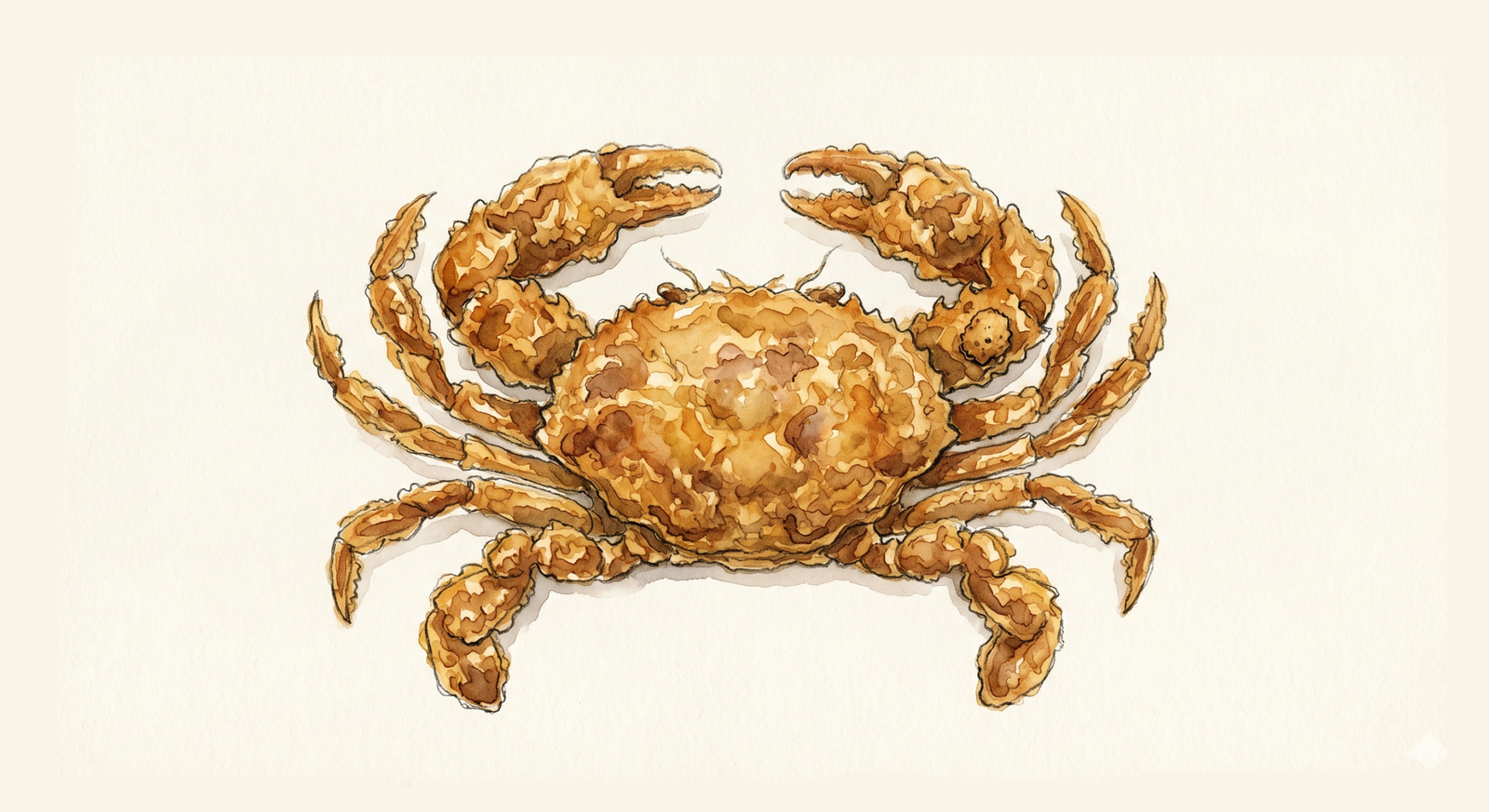
The first time most people encounter soft-shell crab, the question is the same: you eat the whole thing? The answer is yes — shell, legs, claws, body — and once you understand what a soft-shell actually is, that answer stops being surprising and starts being the whole point. A soft-shell crab is a blue crab caught in the brief window after it has shed its hard shell and before the new one has hardened. That window is roughly two to three days. The season itself runs six to eight weeks across the Chesapeake and Carolina coasts. What you are eating, when you eat one in May on the South Carolina coast, is a creature that has been waiting all year to make that transformation — and a waterman who has been watching for it almost as long.
What a Soft-Shell Crab Actually Is
Blue crabs molt. They shed their hard shell roughly twenty times over the course of their lives as they grow, and each time they do, the new shell starts out completely soft. At that moment, the crab is entirely edible: the shell that would otherwise be an obstacle is thin, pliable, and becomes crisp when cooked. What makes it extraordinary at the table is exactly what makes it vulnerable in the water. A blue crab in that soft state has no defense. It hides under grass and debris and waits for the new shell to harden. If a waterman finds it first, it ends up in a basket on its way to market.
The crab itself — Callinectes sapidus, which translates from Latin as “beautiful savory swimmer” — is the same animal that appears in crab cakes, she-crab soup, and steamed hard crabs across the mid-Atlantic and South. The difference is entirely in the moment of harvest. Hard-shell blue crabs require work: crackers, mallets, patience, a newspaper-covered table. A soft-shell crab requires none of that. The entire animal goes on the heat and comes off ready to eat.
Why Timing Is Everything
The signs of an imminent molt are visible on the crab’s body days in advance — particularly a pink or red line along the edge of the back fin. Crabs showing those signs are called peelers. They are collected from crab pots and held in floats — shallow, submerged enclosures in tidal water — where watermen can watch them and pull them at the exact right moment. That moment matters more than most people realize.
Once a crab actually sheds its old shell, the window to harvest it as a soft-shell is measured in hours, not days. The crab immediately begins pumping itself full of water to stretch the new, pliable skin outward. Within two to four hours, that skin starts toughening into what watermen call a leatherback — not fully hard, but no longer the paper-thin softness that makes the crab worth eating whole. Watermen check their floats every few hours, day and night, through the peak of the season. Miss the window and the crab is already on its way back to being a hard-shell.
That labor intensity is what makes soft-shell crab a seasonal treat rather than a year-round product. Once harvested, soft-shells must be sold and eaten within days. They can be frozen, and many are, but a frozen soft-shell and a fresh one are not the same product. The texture changes, the sweetness fades, and what should be crisp becomes soft in ways that make you wonder what the fuss was about. The season exists because the alternative is a lesser dish.
Peak season runs May through early June along the Chesapeake Bay and the Carolina coast, driven by water temperature. The Gulf Coast — Louisiana, Mississippi, Alabama — actually runs ahead of both, with the first soft-shells appearing in late March or early April when Gulf water temperatures climb past 65 degrees. For a Southern eater paying attention, the season rolls north across roughly six weeks: Gulf Coast in late March, the Carolinas in late April, the Chesapeake through May and into June. The Sea Island estuaries around Port Royal Sound produce some of the earliest soft-shells on the Carolina coast — one reason the town of Port Royal, South Carolina hosts its annual Soft Shell Crab Festival in late April, timed to anchor the start of peak season. The 2026 festival ran April 18 on Paris Avenue, a one-day waterfront event that moves at the pace of the harvest rather than the calendar.
The Festival as Reference Point
The Port Royal Soft Shell Crab Festival is where the dish makes most sense to a newcomer. The setting is the waterfront, the crabs are coming directly out of the surrounding estuaries, and the preparation is straightforward enough to not get in the way of the crab itself. A fried soft-shell on a sandwich with slaw is the correct way to eat one for the first time: the crab fried hot and whole, the shell crisped to a crackling crunch, the sweet meat inside still tender, the slaw providing a cool, acidic counterpoint to the heat and fat. That combination is not complicated and it does not need to be. The crab is the argument.
Port Royal sits in Beaufort County, in the heart of South Carolina’s Sea Island country. The waterways around it — the Broad River, the Coosaw River, Port Royal Sound — are the same estuaries that produce the Lowcountry’s oysters and shrimp. The soft-shell festival is a working waterfront town doing what working waterfront towns do: building an occasion around the thing they harvest best at the moment it is at its best.
How a Soft-Shell Crab Gets Prepared
The cleaning step is what separates a properly prepared soft-shell from one that is not. Before cooking, the crab needs to have its gills removed — feathery gray structures on either side of the body, also called dead man’s fingers — along with the apron on the underside. This is a thirty-second task for anyone who has done it before, and most fish markets and restaurants handle it at the counter. If you are buying live soft-shells to cook at home, ask the fishmonger to clean them. An uncleaned soft-shell is edible but the gills contribute a bitter, sandy quality that gets in the way.
After cleaning, the two serious preparations are frying and sautéing in butter. Each produces a different dish.
Fried, the crab gets dusted in seasoned flour or a light cornmeal coating — not a heavy batter, which would mask the delicacy of the shell — and goes into hot oil. The goal is a shell that crisps to a shatter while the meat inside stays tender and sweet. The legs and claws crunch. The body has snap. The whole thing comes together in three to four minutes. This is the sandwich preparation: on white bread or a soft roll with Duke’s mayonnaise and slaw, or with remoulade if you are working in a Louisiana context.
Sautéed in brown butter with capers, lemon, and parsley — the meunière preparation that New Orleans institutions like Galatoire’s and Commander’s Palace have built around this dish — the approach is restrained in a way that lets the crab’s flavor come forward rather than its texture. This version is more common in fine-dining contexts and in New Orleans, where soft-shells appear on menus in late April alongside the rolling Gulf seafood calendar. The butter picks up the flavor of the shell as it renders, and the capers provide the acid that slaw provides in the fried sandwich version.
Both are correct. The fried version is more honest to the tradition. The sautéed version is more elegant and arguably reveals more of what the crab actually tastes like.
What You Are Actually Tasting
A properly cooked soft-shell crab tastes like the sea, and then like sweet crab, and then like the fat of whatever it was cooked in. The shell itself does not taste like much — it contributes texture, not flavor. What the crisp exterior provides is contrast: the crunch of the shell against the yielding sweetness of the meat makes both elements more noticeable than either would be alone. It is the same logic as a fried oyster — the frying is not hiding the shellfish, it is giving you something to bite through before you reach it.
The legs and claws are the best part and the part most first-time eaters are uncertain about. They get fully crisp in the oil and shatter cleanly. The knuckle meat in the claws, tiny as it is, is often the sweetest bite on the whole crab. Do not pick around them.
What Season Actually Means at a Restaurant
Soft-shell crabs appear on menus in May and June and are gone by mid-summer. Any restaurant listing them in August is using frozen product, which is worth knowing before you order. The conversation to have is simple: are these fresh or frozen? A kitchen working with fresh soft-shells during the actual season will know the answer immediately. A kitchen that hesitates is probably using frozen.
The frozen version is not inedible. It is a meaningfully different product. The shell does not crisp as cleanly. The meat is softer than it should be. The sweetness that makes a fresh soft-shell remarkable is partially gone. If you are eating soft-shells for the first time from frozen product out of season, you are meeting a lesser version of the dish and forming an opinion that does not hold.
The correct move is to eat them in May or June from a restaurant or market that knows its supplier. A fish counter that can tell you what waterway the crabs came from is a fish counter that can tell you they are fresh.
What to Skip
Any soft-shell crab in a heavy beer batter has been overcomplicated. The shell does not need protection. It needs direct contact with hot oil so it can crisp on its own. A thick coating insulates the shell from the heat, producing something soggy where it should shatter.
Frozen soft-shells passed off as fresh are common enough to watch for. The season is short, demand is high, and the price difference is meaningful. Fresh soft-shells are expensive. If a restaurant is offering them at a price that seems too reasonable for the season, the frozen version is probably the explanation.
Soft-shell crabs outside the Chesapeake and Carolina coast corridor require more scrutiny. The dish travels, and it travels unevenly. The further from the source, the more likely the product is frozen, and the more likely the kitchen has not worked with them often enough to know exactly how to handle the cleaning and the cook time.
How to Think About Soft-Shell Crab: The Transferable Framework
Two questions determine whether a soft-shell crab is worth ordering. First: is it the season? May through June on the Atlantic coast and Carolinas. Outside that window, the product is frozen. Second: is the preparation minimal? Lightly floured and fried, or sautéed in butter. Anything that adds more coating, more sauce, or more complexity than the crab needs is getting in the way of the reason you ordered it.
The dish rewards one simple habit: eating the whole thing without hesitation. The legs, the claws, the body — the whole crab was cleaned and cooked to be eaten that way. Once you stop picking around the parts that look unfamiliar and just bite through, the reason it is a once-a-year event becomes immediately clear. There is nothing else that tastes like it, and the fact that it only comes around for six weeks is not a limitation. It is the reason it matters when it does.