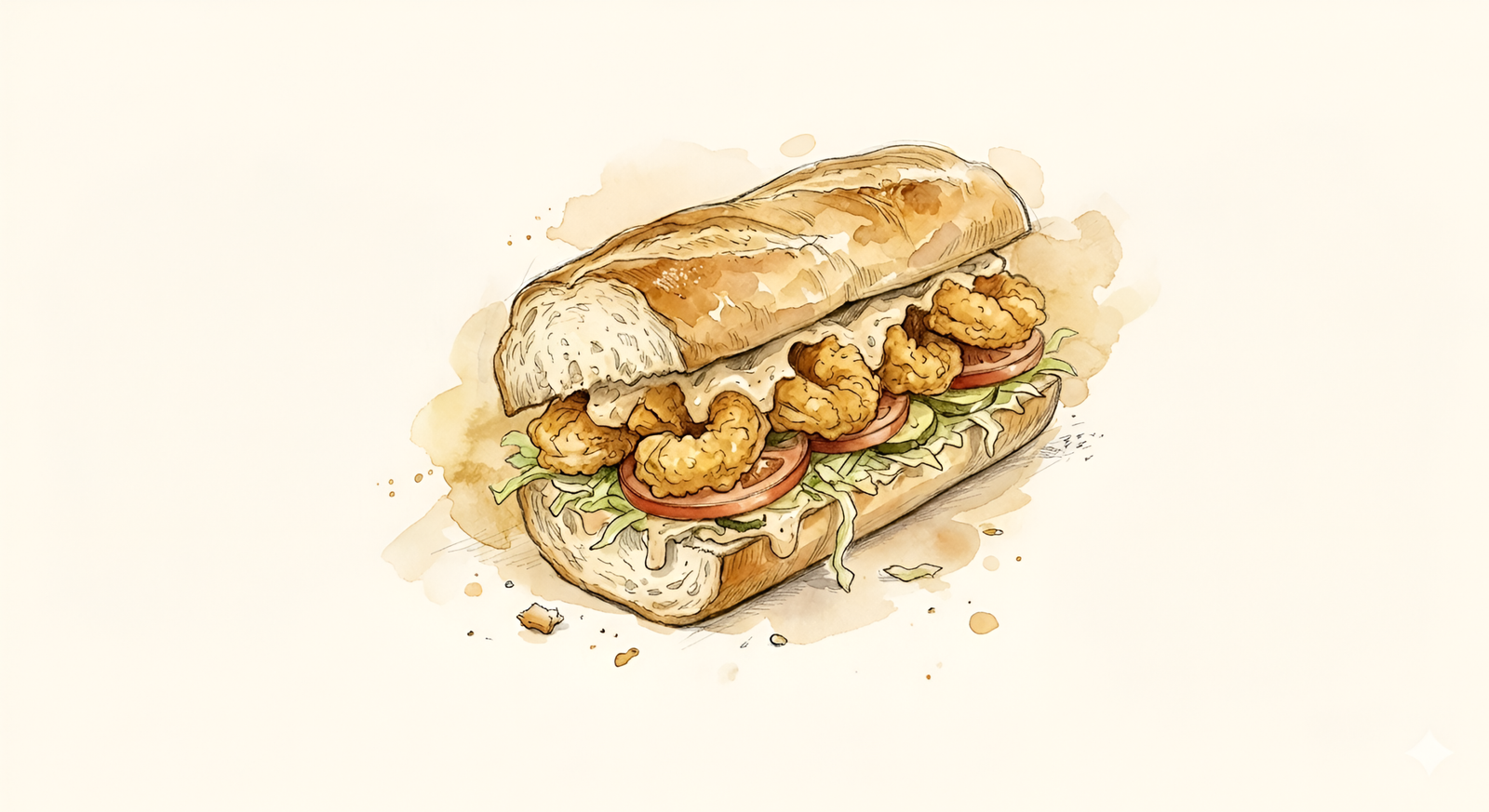
New Orleans Po’boy Guide: How to Order, Eat, and Think About It
A po’boy is defined by its bread, not its filling — and that bread cannot be reliably produced outside New Orleans. New Orleans French bread has a crust that fractures on the first bite and a white interior that compresses to almost nothing, creating a structural relationship with fried seafood or roast beef that no other bread replicates. Understanding that dynamic is what separates a meaningful po’boy experience from a tourist transaction.
What Makes a Po’boy Different From Other Fried Sandwiches
The bread is the defining element. New Orleans French bread — produced by a small number of local bakeries, most notably Leidenheimer (operating since 1896), Alois J. Binder, and Gendusa’s, the three operations locals argue over endlessly — has a thin, crackling crust and a cloud-soft interior engineered to amplify rather than compete with a fried filling. When the crust fractures and the interior yields at the same moment the fried shrimp or oyster gives way, you are tasting a bread built, over decades, for exactly that behavior.
Put the same filling on a hoagie roll and the bread’s density fights the filling. Put it on a ciabatta and the chew overwhelms the shrimp’s texture. The New Orleans loaf is deliberately neutral in crumb and sharp in crust. That is not an accident of geography. It is the point.
Why Po’boy Bread Cannot Be Replicated Outside New Orleans
Bakers outside the region have consistently failed to reproduce New Orleans French bread. The likely factors are the mineral profile of New Orleans water, the Gulf Coast humidity that affects fermentation timing, and a steam-injection baking method that produces a crust thin enough to fracture without the resistance of a standard French loaf. Several Louisiana bakeries have arrived at the formula. No one outside the region reliably has.
This matters practically: a po’boy made on the wrong bread is a different, lesser sandwich. The dressed toppings can be right, the hot sauce can be right, the shrimp can be right, and the result will still disappoint. Before you decide what to order, make sure you are in a shop using the correct bread. The crust should shatter when you bite it. If it does not, find a different shop.
Roast Beef Po’boy vs. Fried Seafood Po’boy: How to Choose
These are two distinct traditions, not two versions of the same thing.
The roast beef po’boy is the older form. The debris version — shredded beef and drippings scraped from the bottom of the roasting pan — emerged from the economics of commercial kitchens where the pan scraps were too rich to discard. Piled onto New Orleans French bread, the drippings soak into the soft interior without turning it heavy, and the crust stays intact long enough to eat. This dynamic is specific to this bread. Change the bread and the soaking breaks.
The fried seafood po’boy is the Gulf Coast form of the same logic. Cornmeal-dusted shrimp, oysters, or catfish, fried hot and placed immediately into the loaf, create a double crunch on the first bite: the crust fractures and the fried coating fractures at the same moment. The bread’s neutral interior absorbs enough oil to stay cohesive.
Which tradition to order depends on the season.
When to Order Oyster vs. Shrimp: The Seasonal Calendar
Gulf seafood follows a cold-water calendar that changes the correct order by month.
October through March: Gulf oysters run at cold-water peak — firm, briny, and fat enough that the fried version holds its texture against the bread. The oyster po’boy is the correct order in these months.
June through September: Gulf water temperatures rise and oyster quality drops. Gulf white shrimp peak in summer, running sweet and large. The fried shrimp po’boy is the right call from June through August.
April and May: The brown shrimp season opens in late spring with a slightly richer flavor. Either shrimp or oysters works in this window depending on conditions — and Gulf temperatures have been running warm enough in recent years that the brown shrimp season has started as early as mid-April. Check local conditions before you commit.
This is not seasonal preference. It is the difference between an oyster po’boy that makes sense and one that disappoints.
What “Dressed” Means on a Po’boy
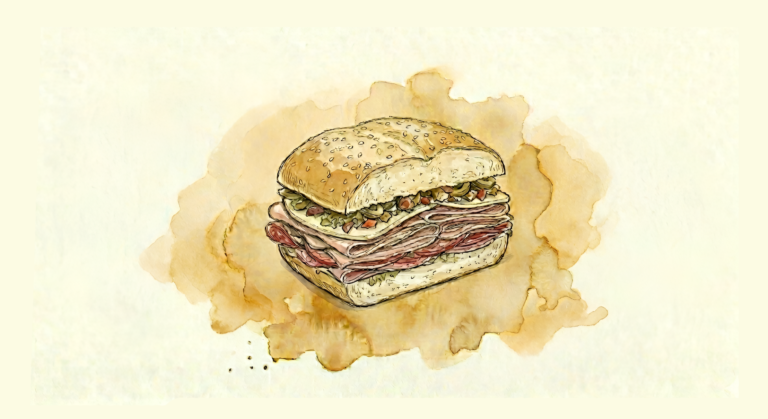
Dressed means shredded lettuce, sliced tomato, pickles, and mayonnaise. In New Orleans this is not a list of toppings — it is the default state of a po’boy. You say dressed or undressed. Dressed is the answer.
The mayonnaise functions structurally. It binds the fried filling to the bread’s soft interior, prevents the crust from tasting dry against the crunch of the filling, and softens the tomato’s acidity into something that supports rather than fights the fried element. The lettuce provides cold contrast. The tomato cuts the fat. The pickles reset the palate. These are not garnishes. They are the architecture of the sandwich, and the combination has not changed in roughly a hundred years because it does not need to.
Crystal vs. Tabasco: Which Hot Sauce to Use on a Po’boy
Crystal is the correct hot sauce for a po’boy. Its vinegar-to-pepper ratio is lower than Tabasco’s, which means it adds heat and a gentle acid note without cutting through the flavor of the shrimp or the beef. It supports the sandwich.
Tabasco is a different product with a different purpose. Aged in white oak barrels on Avery Island in Iberia Parish, it carries barrel-derived complexity and a sharper, more penetrating vinegar bite. That quality makes it excellent on raw oysters on the half shell and in cooking applications where you want the pepper flavor to assert itself. On a po’boy, where the bread and filling are working together, Tabasco’s sharpness is too insistent.
Most po’boy counters in New Orleans stock both. Reach for the Crystal on the po’boy. If you want to understand what Tabasco is built for, order raw Gulf oysters alongside and try it there.
Where to Eat a Po’boy in New Orleans
The French Quarter has po’boy shops. Most serve tourists and many use bread that is close but wrong — it looks right and lacks the crust behavior that defines the sandwich. The institutions are in Uptown and Mid-City.
Parkway Bakery and Tavern (Mid-City) — The consistent local reference for roast beef. Order the debris. Expect a line on weekends. The wait is part of the transaction.
Domilise’s (Uptown) — Same corner location for generations. Old-school vibes; they’ve recently started taking cards, but cash is still the local language here. The fried shrimp po’boy is the order. If you want to understand what the bread is doing without the richness of roast beef drippings, start at Domilise’s.
R&O’s Restaurant (Metairie) — Just outside the city. Draws roast beef partisans who consider it the better version of the debate. Worth the drive if you are already spending a day eating across the metro area.
Mahony’s Po-Boy Shop (Magazine Street) — The best option within reasonable distance of the French Quarter. Bread is right, quality is consistent.
Killer Poboys (French Quarter) — The rule-breaking exception worth knowing about. Killer Poboys uses Vietnamese-French bread from Vinh Hoa, not traditional New Orleans French bread, and the results are deliberately different: a thinner, crispier shell with a tighter crumb. It has become its own significant sub-culture within the modern New Orleans po’boy conversation. Go in knowing what it is — a serious sandwich making its own argument — rather than a traditional benchmark.
What to Skip: How to Identify a Po’boy Made on the Wrong Bread
Any po’boy shop on Bourbon Street or in the immediate tourist corridor deserves skepticism. The issue is not necessarily the filling — it is the bread. High-volume tourist operations frequently use dense sub rolls or hoagie bread that look similar at a glance and produce a fundamentally different sandwich.
The test is simple: if the crust does not shatter on the first bite, the shop is not using New Orleans French bread, and the sandwich in your hands is not a po’boy in the meaningful sense. You can leave without ordering and find the correct version within a few blocks.
The same applies anywhere outside New Orleans that claims to serve a po’boy. The filling might be good. Without the bread, you are eating a fried shrimp sandwich — which can be excellent — but it is a different thing.
How to Think About a Po’boy: The Transferable Framework
The bread is the reason the sandwich exists. Every other decision flows from that starting point. Order at a shop that uses the correct bread. Order dressed. Use Crystal. Let the season tell you whether to order shrimp or oysters. That is the complete framework.
When you eat a po’boy made correctly in New Orleans, the double crunch at the first bite — crust fracturing, fried coating fracturing — is not a lucky coincidence. It is the result of a specific bread engineered over a century for a specific filling in a specific place. That understanding makes every po’boy you encounter after this one more legible: you know what you are looking for, and you will know immediately whether you found it.