Lowcountry Cuisine Explained: What It Is, Where It Comes From, and Why It Tastes the Way It Does
Lowcountry Cuisine Is Not a Style. It Is a Geography, a History, and a Set of Ingredients That Cannot Be Separated From Either.
Lowcountry cuisine is what happens when a specific geography forces specific ingredient choices, and several distinct groups of people each adapt their culinary traditions to work within those constraints. The result is not a fusion cuisine or a style invented by a chef. It is a cooking system built around tidal coastline, rice paddies, and estuaries along the South Carolina and Georgia coasts, shaped primarily by the West African people who were enslaved there and whose agricultural knowledge made the whole economy possible.
Understanding what Lowcountry food is requires understanding the place first. The cuisine follows directly from the land.
What the Lowcountry Actually Is
The Lowcountry is a specific coastal geography: the tidal flatlands, barrier islands, salt marshes, and river deltas that run along the South Carolina and Georgia coastlines. The region sits at or near sea level. The terrain is defined by water moving in and out with the tides, which creates a particular set of conditions for agriculture and for the seafood that lives in that tidal zone.
The term covers a corridor from the Pawleys Island and Georgetown area of South Carolina south through coastal Georgia, with Charleston and Savannah as the two anchor cities. The traditional core runs from the Santee River south to the Savannah River; coastal Georgia extends the geography because of its shared Gullah Geechee heritage and rice culture. The Lowcountry designation does not extend north into North Carolina — the Cape Fear region around Wilmington is a distinct coastal tradition. The Sea Islands, a chain of barrier islands separated from the mainland by tidal creeks and rivers, sit at the center of both the geography and the culinary tradition.
This place produces specific things. Oysters, shrimp, blue crab, and fish live in the tidal waters. Rice grew in the freshwater swamps inland from the coast. Field peas, okra, and corn grew in the sandy soil. The cuisine built itself around those ingredients because those were the ingredients the place offered.
How Rice Shaped Everything
Rice is the foundation of Lowcountry cooking in a way that has no parallel in other Southern regional cuisines. Rice cultivation flourished in South Carolina tidal swamps from the late 1600s onward, and for nearly two centuries it drove the regional economy. The variety that defined the region was Carolina Gold, prized for its flavor, texture, and the way it cooked: each grain distinct, slightly nutty, with a body that held up to long-simmered dishes.
Enslaved West Africans arrived in the Lowcountry in the late 1600s. Many came from the Rice Coast spanning Senegal, Gambia, Sierra Leone, and Liberia, where rice cultivation had been practiced for centuries. They brought expertise in tidal irrigation systems, wetland management, and sustainable rice-harvesting techniques that plantation owners had no knowledge of and could not replicate on their own. By the 1720s, primary source records show Carolina rice growers were telling slave traders that they wanted skilled Africans from the Rice Coast above all others — the success of the entire operation depended on their agricultural knowledge. The people being enslaved and transported were skilled, knowledgeable farmers. The wealth of the Lowcountry rice economy was built on their stolen knowledge and forced labor.
Rice appears in almost every traditional Lowcountry dish. Red rice, Hoppin’ John, purloo, chicken bog, and crab rice are all one-pot rice dishes that trace directly to West African cooking traditions adapted to local ingredients. Even shrimp and grits, which substitutes stone-ground corn for rice, follows the same structural logic: a grain base carrying a protein and a sauce.
Carolina Gold nearly disappeared after the Civil War ended the plantation system. Anson Mills in Columbia, SC, has spent decades reviving heritage grain varieties including Carolina Gold, and today Charleston chefs source it regularly. The grain on a serious Charleston menu is not a nostalgic gesture. It is the original ingredient.
The Tidal Geography and What It Produces
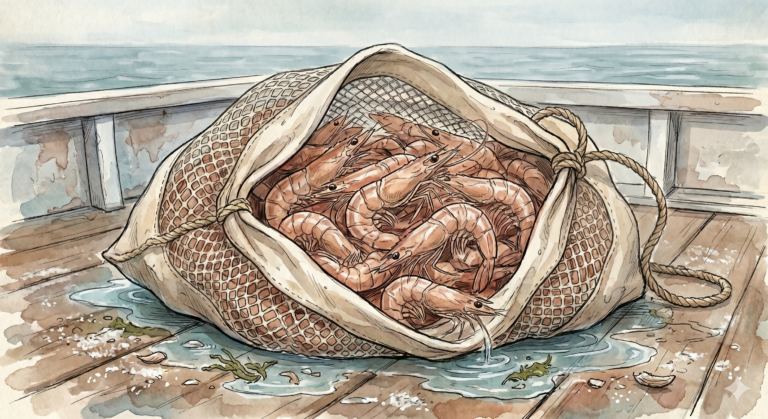
The seafood that defines Lowcountry cooking comes directly from the tidal zone. Oysters grow on the exposed shell beds of tidal creeks. Shrimp move through the estuaries with the seasons. Blue crabs feed in the marsh grass. The proximity of this supply chain to the kitchens that use it is what separates Lowcountry seafood cooking from imitations elsewhere.
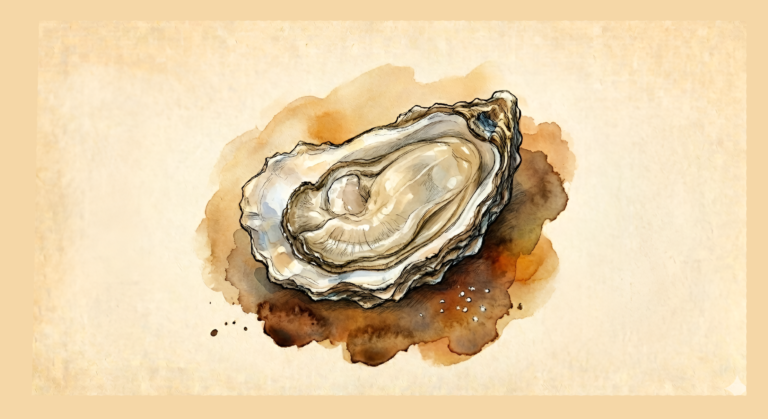
The oyster roast is the most distinctly Lowcountry expression of this geography. Clusters of shell oysters, pulled from local creek beds, steamed over an open fire on a sheet of metal, eaten standing up with a knife and a towel. The format exists because the oysters are there, because the tradition of communal outdoor cooking is there, and because the season lines up: Lowcountry oysters run October through March, peaking in the coldest months when the water tightens the meat.
Brown shrimp run through summer and white shrimp carry through fall. Blue crab seasons span spring through fall across the Carolinas and Georgia coast. A kitchen paying attention to this calendar cooks a different menu in October than it does in June.
The Gullah Geechee Foundation
Any account of Lowcountry cuisine that focuses on the geography and ingredients without accounting for the people who developed the cooking system is incomplete. Under slavery, Lowcountry Black people and their descendants, known as the Gullah Geechee people, fashioned a unique creole culture — a blend of African and European influences — and created the only English-based creole language indigenous to the United States alongside a distinctive cuisine based on rice.
The Gullah Geechee people brought specific ingredients and techniques from West Africa. Benne seeds, which are sesame seeds, came with the earliest arrivals and remain in use in Charleston baking today — most specifically in the Benne Wafer, a thin, crisp cookie that is one of the most distinctly Charleston food items in existence. Okra, field peas, and specific one-pot cooking methods all have West African roots adapted to Lowcountry ingredients. After the Civil War, freed people settled on the Sea Islands and in the Lowcountry, where they grew rice for their own sustenance, and dishes like red rice, crab rice, okra with rice, and Hoppin’ John became one-pot mainstays of their dining tables.
The influence of Gullah Geechee culture on what is now marketed as Charleston cuisine is both central and frequently understated in food media coverage — including coverage like this guide, which is produced outside that community. The dishes on most Charleston restaurant menus trace their origins to a cooking tradition that the Gullah Geechee people sustained and preserved, and that tradition is now largely sold commercially by non-Gullah Geechee restaurants, chefs, and publications. That context belongs in any honest account of what the food is and where it came from, which is why sourcing the grain, understanding the seasonal calendar, and directing readers toward the Gullah Geechee Cultural Heritage Corridor matters more than any restaurant recommendation.
The Dishes That Define Lowcountry Cuisine
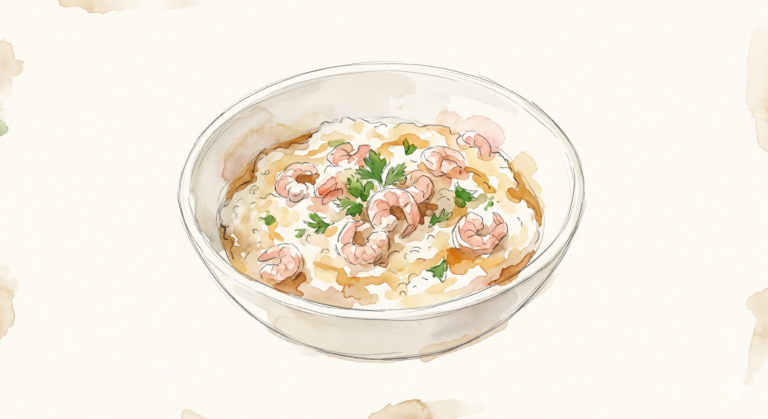
Shrimp and grits. The most recognized Lowcountry dish nationally. Local shrimp, stone-ground Carolina grits, a pan sauce built on pork and vegetables. The original form was a working breakfast called “shrimp and breakfast hominy.” See the Shrimp and Grits in Charleston guide for the full breakdown.
Hoppin’ John. Field peas and rice cooked together, typically with pork. Eaten on New Year’s Day across the South for luck, but a year-round staple in Lowcountry cooking. The pea-and-rice combination is West African in origin.
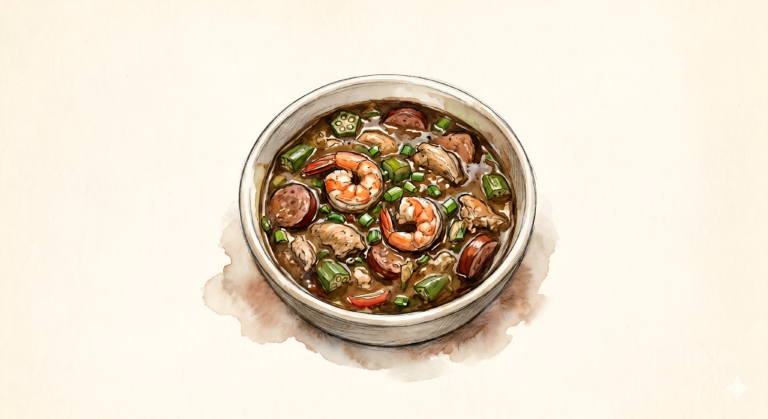
Red rice. Rice cooked with tomatoes, onions, and smoked sausage in one pot. A direct descendant of West African jollof rice adapted to local ingredients.
Purloo. A one-pot dish of rice cooked in broth with whatever protein and vegetables are available. The Lowcountry version of a technique that runs across West African cooking traditions.
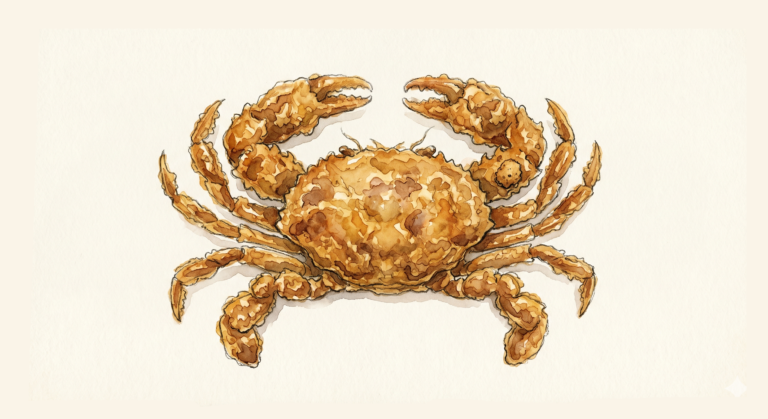
She-crab soup. A Charleston-specific soup built on blue crab, crab roe, cream, and sherry, popularized by William Deas, a Gullah chef and cook for Charleston mayor R. Goodwyn Rhett, in the early twentieth century — the connection to the mayor’s household is how the dish moved from a private Lowcountry staple to a city signature. The roe gives it a signature orange hue and a richness distinct from any other crab soup in the region. Because harvesting female crabs is regulated to protect populations, many modern restaurants substitute crumbled hard-boiled egg yolk for the roe or omit it entirely. A kitchen that names the roe — or honestly notes its absence — is a kitchen paying attention to what the dish actually is.
Lowcountry boil. Originally called Frogmore Stew, after the community on St. Helena Island where the format is rooted. Shrimp, corn, smoked sausage, and potatoes cooked together in a seasoned broth and dumped on a table covered in newspaper. A communal format tied to the same outdoor cooking tradition as the oyster roast.
Oyster roast. Clusters of shell oysters steamed over an open fire, eaten standing up. The most place-specific format in Lowcountry cooking. It only makes sense where the oysters come from the water nearby.
Where Lowcountry Cuisine Lives Today
Charleston and Savannah are the two cities where the full tradition is most accessible to visitors. Charleston has the denser concentration of serious Lowcountry cooking, driven in part by the James Beard attention the city’s restaurant scene has received over the past two decades.
The most important Lowcountry ingredient story is happening partly outside restaurant kitchens. Anson Mills in Columbia and Marsh Hen Mill on Edisto Island are both actively reviving heritage grain varieties, including Carolina Gold rice and Jimmy Red Corn. The ingredient work those mills are doing is what makes the serious Lowcountry cooking in Charleston possible.
The Sea Islands, particularly the areas around Beaufort and the Georgia coast near Savannah, hold more of the living Gullah Geechee culinary tradition than any restaurant district. That tradition is documented and accessible through culinary heritage organizations and specific community events, though it is not primarily a tourist-facing culture.
What Lowcountry Cuisine Is Not
Lowcountry cuisine is not a general term for Southern coastal cooking. Gulf Coast cooking is a different tradition. Florida cooking is a different tradition. The Outer Banks has its own seafood traditions. The Lowcountry is a specific geography with a specific history, and the cuisine reflects both.
A restaurant using the term without the ingredients to back it up is using it as atmosphere rather than accuracy. The markers worth looking for: local shrimp sourced by season, stone-ground grits from a named Carolina mill, rice dishes with genuine Lowcountry roots. A kitchen that names its grain supplier, lists the season of its shrimp, and serves one-pot rice dishes alongside its seafood is engaged with the actual tradition. A kitchen that lists “Lowcountry” in the restaurant name but sources neither grain nor seafood locally is using the word as décor.
How to Think About Lowcountry Cuisine: The Transferable Framework
Lowcountry cuisine is legible once you understand its three organizing principles: the tidal geography determines the protein, the West African agricultural tradition determines the grain and the cooking method, and the season determines when those two things are at their best together.
Apply those principles at any table. Is the shrimp local and in season? Is the grain stone-ground and sourced from a named Carolina mill? Does the dish follow the one-pot structural logic that connects this food to its West African roots? A kitchen that answers yes to all three is serving Lowcountry cuisine in the meaningful sense. A kitchen that answers no to all three is serving the brand of it.
The framework works in both directions. It tells you when to trust the menu and when to ask harder questions. A serious Charleston meal, a Savannah fish house, a Sea Island community event — the same three questions apply everywhere. The answers tell you where you are in the tradition.
For the city-level breakdown, see the Charleston Food Guide. For the dish that has become the most recognized expression of this cuisine nationally, see the Shrimp and Grits in Charleston guide.